
For most U.S. student pilots, three financing routes cover the bulk of real-world cases: private career-training loans through Sallie Mae, association-backed financing through AOPA Flight Training Finance, or a specialist aviation lender like Flight Training Finance LLC. Personal loans and home equity lines of credit (HELOC) work as fallback options when those three don't fit your credit profile or your school's certification requirements.
Here's the quick breakdown:
One caveat that trips up a lot of applicants: most FAA Part 61 schools aren't Title IV eligible, so federal student aid often isn't on the table. Cosigners matter too. A creditworthy cosigner can be the difference between approval and rejection, or between a workable rate and a punishing one.
Flight training financing works best as a stack: a certified-cost loan from Sallie Mae or AOPA for the bulk of tuition, a buffer for extra hours, and a clear repayment plan before you sign anything.
| Point | Details |
|---|---|
| Start with certified cost | Get your school's certified cost estimate before applying to any lender. |
| Compare at least two lenders | Prequalifying with multiple lenders reveals real rate and term differences. |
| Borrow with a buffer | Plan for a buffer above the quoted minimum to cover weather and extra hours. |
| Know the funding gap | Approval can come fast, but funds often take a few days to reach your school. |
| Clarify cosigner terms | Ask about cosigner-release timelines before committing a cosigner to the loan. |
The four routes below differ less in whether they'll lend you money and more in how fast you get it, what strings come attached, and who qualifies.
| Lender / Product | Typical Loan Size | APR Range (2026) | Best For | Eligibility Requirement | Decision / Funding Timeline |
|---|---|---|---|---|---|
| Sallie Mae (Smart Option & Airline Career Loan) | Up to 100% of certified costs | Fixed and variable rates, cosigner dependent | Full program financing, career-track students | School certification required; cosigner often needed | Fast decision; funding tied to school certification |
| AOPA Flight Training Financing | Line-of-credit style, draw as needed | Published rate tiers | Members flying at AOPA-affiliated schools | Often AOPA membership | Decision in about 1 business day, funding in 2 to 3 business days once documents are in |
| Flight Training Finance LLC (specialist lender) | Advertised up to $100,000 | Varies by school partnership | Students at schools with lender partnerships | School must participate in lender's network | Approval and funding can take roughly two weeks |
| Personal loan / HELOC | Depends on income or home equity | Market rate, no aviation discount | Small top-ups, bridging a funding gap | Standard consumer credit underwriting | Personal loans fast; HELOC slower due to appraisal |
If your priority is speed, look at the timeline column first. If you're trying to minimize total interest paid, the APR range matters more than how fast the money lands. And if you're not an AOPA member yet, factor in that membership requirement before you assume that row applies to you.
Four product categories cover almost every financing scenario a student pilot runs into.
Start with APR structure. A fixed rate protects you from payment shock; a variable rate might start lower but can climb during a multi-year training path. Next, check in-school payment options: some lenders let you defer payments entirely, others require interest-only payments, and some lock you into a flat $25 monthly payment while you're still training.
Ask your lender and your school these questions directly:
Watch for red flags: unclear fee disclosures, a school that insists you use only one lender, or a funding timeline that keeps slipping without explanation. Applicants who prequalify with at least two private lenders and get a school-certified cost estimate before signing tend to finish their programs with more manageable debt loads than those who commit to the first offer they see.
The process moves faster than most first-time borrowers expect, but the gap between "approved" and "money in the school's account" is where people get caught off guard.
If you're using a line-of-credit model, draws happen as lessons occur, not all at once, so planning with the best flight school scheduling software can help you align training and funding effectively. Plan your lesson schedule with that in mind, or you risk a funding gap mid-course.
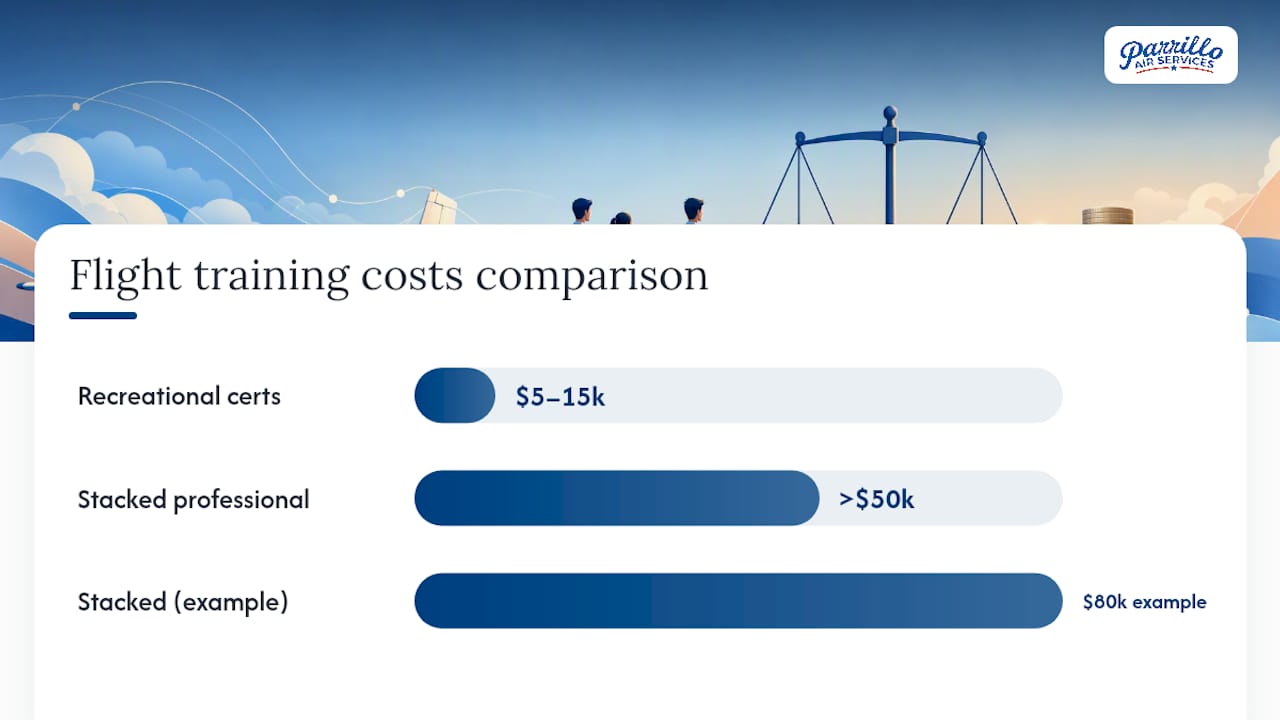
Program costs swing widely depending on your track. Recreational certificates typically run $5,000 to $15,000, while stacked professional paths, private through commercial and instrument, can climb well past $50,000 once you add multi-engine and certified flight instructor ratings.
Weather cancellations, aircraft maintenance, and the extra practice hours almost every student needs will eat into a bare-minimum budget fast.
Here's what monthly payments look like on a standard repayment term:
For a deeper cost breakdown by certification stage, our pilot training costs guide walks through each stage separately.

Parrillo Air Services runs FAA Part 61 training in Lynchburg, Virginia, covering discovery flights through private pilot, instrument, commercial, and flight instructor certification, with scheduling support for Liberty University credit transfer. That structure matters for financing because certified cost estimates are exactly what lenders like Sallie Mae and AOPA require before releasing funds.
Parrillo Air Services helps students:
If you want a program-specific cost estimate to bring to a lender conversation, request one through Parrillo Air Services' training programs page.
| Factor | What It Means for Financing |
|---|---|
| Part 61 structure | Certification letters are prepared to match lender documentation needs. |
| Career-path guidance | Loan amounts get sized against your actual certification track, not guesswork. |
| Liberty University credit transfer | Relevant if you're stacking financial aid with a degree program. |
Applying for any loan triggers a hard credit inquiry, which typically dips your score by a few points for a short stretch. That's minor compared to what happens after you start repaying. On-time payments on a career-training loan build payment history, the single largest factor in most credit scoring models, and a strong record here can improve your score meaningfully over a few years.
The bigger long-term factor is debt-to-income ratio. A $40,000 to $60,000 loan is a real monthly obligation, and lenders evaluating you for a future mortgage or auto loan will weigh it accordingly. This matters more for aspiring pilots than most other career-training borrowers because the payoff, an airline first-officer salary, often takes two to three years of regional-airline experience to materialize. Budget for that gap, not just the loan itself.
Cosigned loans carry a separate risk. If you miss payments, your cosigner's credit takes the hit too, and that can strain the relationship long before it strains your credit report. Ask about cosigner-release provisions upfront so you and your cosigner both know when that liability ends. Some lenders release a cosigner after a set number of consecutive on-time payments, usually somewhere between 12 and 48 months depending on the product.
Refinancing becomes relevant once you're employed and your credit profile has improved since your original application, often the case for pilots a year or two into a regional airline job. A lower rate on a $50,000 balance can save you thousands over the remaining term, particularly if your original loan carried a variable rate that's since climbed.
Consolidation works differently: it combines multiple loans (say, a Sallie Mae loan plus a personal loan you used for extra hours) into a single monthly payment. This simplifies bookkeeping but doesn't always lower your rate, so run the math before committing.
A few practical notes. Private loans used for flight training generally don't qualify for federal consolidation programs, since those apply to federal student loans, not the private products most Part 61 students rely on. Refinancing through a private lender is the more realistic path, and it's worth shopping multiple lenders again rather than assuming your original lender offers the best refinance rate. Also check whether your current loan carries a prepayment penalty. Most modern private student and career-training loans don't, but it's worth confirming before you pay off a balance early to refinance elsewhere.
Most financing guides list every lender under the sun and let you sort it out. That's backwards. The real decision isn't which lender exists, it's which one matches your school's certification setup and your timeline tolerance. AOPA's line-of-credit model suits someone training steadily over 18 months. A lump-sum Sallie Mae loan suits someone doing an accelerated program in 6 months. Treating them as interchangeable is where borrowers overpay.
The buffer advice gets dismissed too often as generic caution. It isn't. Underestimating your loan by 20% doesn't mean a minor inconvenience, it means stalling mid-program while you scramble for a second loan with worse terms than your first. Borrow the buffer upfront.
And credentialing matters more than the loan paperwork suggests. A school that can produce a clean, lender-ready cost certification, the kind Parrillo Air Services structures its program documentation around, saves you weeks of back-and-forth that a less organized school will cost you.
— Gm
This article is general information, not a substitute for advice from a qualified financial advisor. Consult a qualified financial professional about your own circumstances before acting on anything here.