The FAA sets clear numeric vision standards by medical class: 20/20 in each eye for first and second class, 20/40 for third class, with near and intermediate benchmarks layered on top. Glasses, contact lenses, and FAA-accepted refractive surgery all satisfy these standards. Color vision deficiencies and other borderline cases have real alternatives, including special tests and a Statement of Demonstrated Ability (SODA), so a failed screening rarely ends a pilot's ambitions on the spot.
TL;DR:
- Most pilots can meet FAA vision standards with correction; if using lenses, a restriction requiring correction must be recorded.
- Failing color vision tests like Ishihara plates can be remedied by alternative tests or a signal-light test, removing restrictions on night flying.
- Refractive surgery is accepted once recovery is complete and properly documented, typically after 6 to 8 weeks, with no automatic waiver invalidation.
- Certain eye conditions like uncontrolled glaucoma or active retinal disease lead to specialist referrals, but stable chronic issues can often be managed with periodic monitoring.
- Vision tests are required at every medical exam, typically every 12 or 6 months depending on certificate class and age, with no separate testing schedule.
The numbers change depending on which medical certificate you're pursuing, and that distinction trips up more student pilots than almost anything else in the certification process. First and second class certificates, the ones required for airline transport pilots and commercial operations, demand sharper distance vision than third class, which covers private and recreational pilots.
Here's how the FAA's Guide for Aviation Medical Examiners breaks it down:
The phrase "with or without correction" is the detail that confuses the most people. It means the FAA doesn't care whether your natural eyesight hits these marks. If glasses or contacts get you there, you qualify. The catch is that once your medical certificate reflects corrected vision, the Aviation Medical Examiner (AME) will almost always attach a limitation stating you must wear corrective lenses while exercising your pilot privileges. This isn't a penalty. It's simply the FAA's way of documenting how you achieved the standard, and it's codified under 14 CFR Part 67 §67.103, the regulation that governs all airman eye standards.
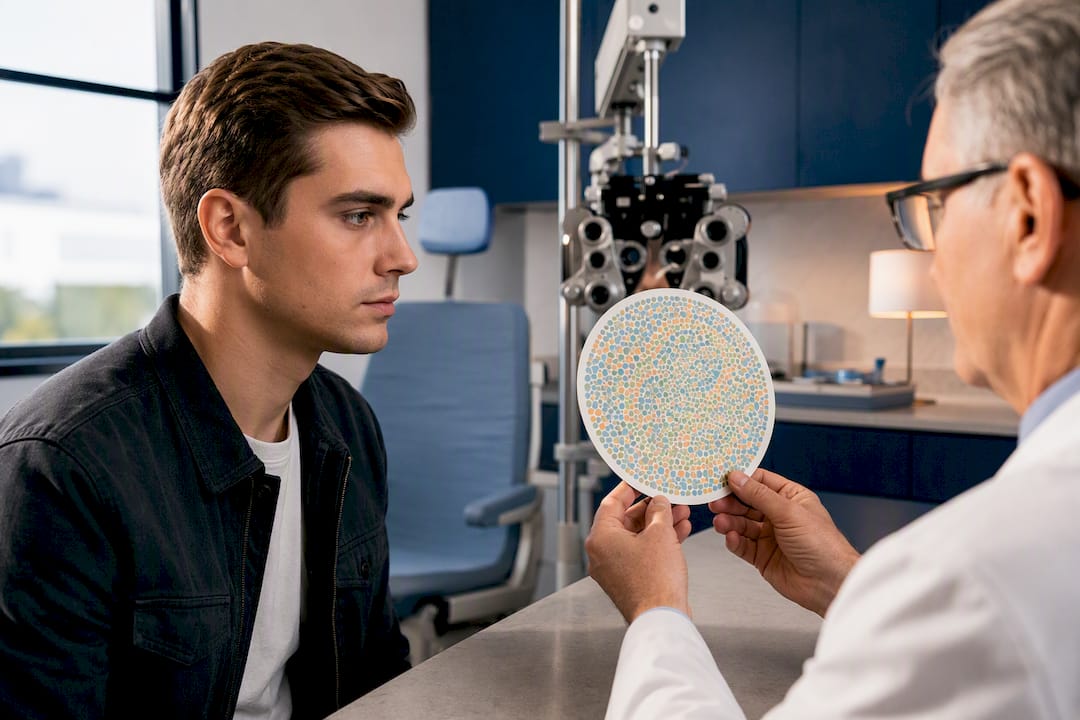
Most pilots first encounter color vision testing through Ishihara plates, the dot pattern test that catches red green deficiencies during a routine AME visit. Failing it doesn't disqualify you. It just means the FAA needs more proof you can safely read colored signals, runway lights, and cockpit displays.
Three paths exist after a failed screening:
Passing the signal-light test removes night-flying and color-signal restrictions from your certificate for good. If you skip these alternatives entirely, expect a limitation restricting you to daylight operations or barring you from relying on color-signal control, which can quietly derail a night flight certification down the road.
Pro Tip: Don't wait until your medical exam to find out you're color deficient. Take an Ishihara test online beforehand so you can schedule the signal-light test in advance instead of getting blindsided at the AME's office.
Glasses and contact lenses are the simplest path to meeting FAA standards, and the overwhelming majority of certificated pilots fly with a corrective-lenses limitation on their medical certificate. There's no stigma attached. The FAA just wants the limitation on record so any examiner or check pilot knows what to expect.
Refractive surgery is where things get more procedural. According to AOPA's guide to medical certification, the FAA accepts LASIK, PRK, and similar procedures as long as recovery is uncomplicated and properly documented. The typical sequence looks like this:
If complications occurred during recovery, expect a longer monitoring period and possibly an additional ophthalmology report before recertification. Pilots who once carried an uncorrected-vision waiver should also know those waivers are no longer valid. If your corrected vision now meets standard, ask your AME to formally remove the outdated limitation rather than assuming it disappears automatically.
Not every eye condition is a simple pass or fail at the AME's office. Certain findings automatically trigger a referral to an ophthalmologist for deeper evaluation, and the FAA's process leans on documentation and demonstrated function rather than blanket exclusion.
Conditions that commonly prompt referral include:
A dilated fundus exam is standard for anyone flagged during these evaluations, and pilots with stable but chronic conditions often end up on periodic ophthalmology follow-up as a condition of keeping their certificate current. Outcomes vary by severity. Some pilots receive a special issuance with monitoring requirements, others undergo a medical flight test to demonstrate they can safely compensate, and a smaller number face denial if the condition genuinely compromises safety. Monocular pilots and those with significant ocular pathology frequently fly under special issuance once properly documented, which underscores how rarely a single diagnosis ends a career outright.
Walking into your AME appointment prepared saves time and avoids unnecessary delays. Here's what to gather beforehand:
During the exam, expect a Snellen chart for distance acuity, near and intermediate vision checks at the standard distances, color plates, and a confrontation visual field test where the examiner checks your peripheral vision manually. Any abnormal finding on these basic tests is what triggers a referral to a specialist rather than an on-the-spot denial.
If you're carrying an old uncorrected-vision waiver and your corrected vision now meets standard, this is the moment to request its removal. Most AMEs can process that update during the same visit, though anything requiring FAA review at the Aeromedical Certification Division in Oklahoma City can take several weeks.
Pro Tip: Call your AME's office a week before your appointment and ask exactly which forms they want in hand. Some offices process eye-related paperwork faster when it arrives before the exam rather than during it.
Parrillo Air Services works with students throughout Lynchburg and the surrounding region on more than stick-and-rudder skills. Vision requirements catch aspiring pilots off guard constantly, and getting ahead of them before your first solo saves real frustration later.
Our instructors routinely walk students through what to expect at an AME visit, what documentation to bring, and how to time a medical exam around a refractive surgery recovery window if that's part of your plan. We also point students toward resources on night flight certification requirements and FAA medical classes, since the class you need depends heavily on your career goals, whether that's flying recreationally or working toward an airline seat.
Our practical advice: run a self-check with an online Ishihara test before your first medical, build in a realistic healing timeline if surgery is on your radar, and coordinate specialist reports early rather than the week before your exam.
Vision testing frequency ties directly to your medical certificate class and age, not a fixed calendar schedule independent of your certification. Every FAA medical exam, whether it's your first or your fifteenth, includes a full vision evaluation as part of the standard physical.
For first class certificates, required for airline transport pilots, the medical (and the vision check within it) is valid for 12 months if you're under 40, and just 6 months once you turn 40. Second class certificates run on a 12 month cycle regardless of age, valid for commercial operations other than airline transport. Third class certificates, covering private and recreational flying, last 60 months if you're under 40 and 24 months if you're 40 or older.
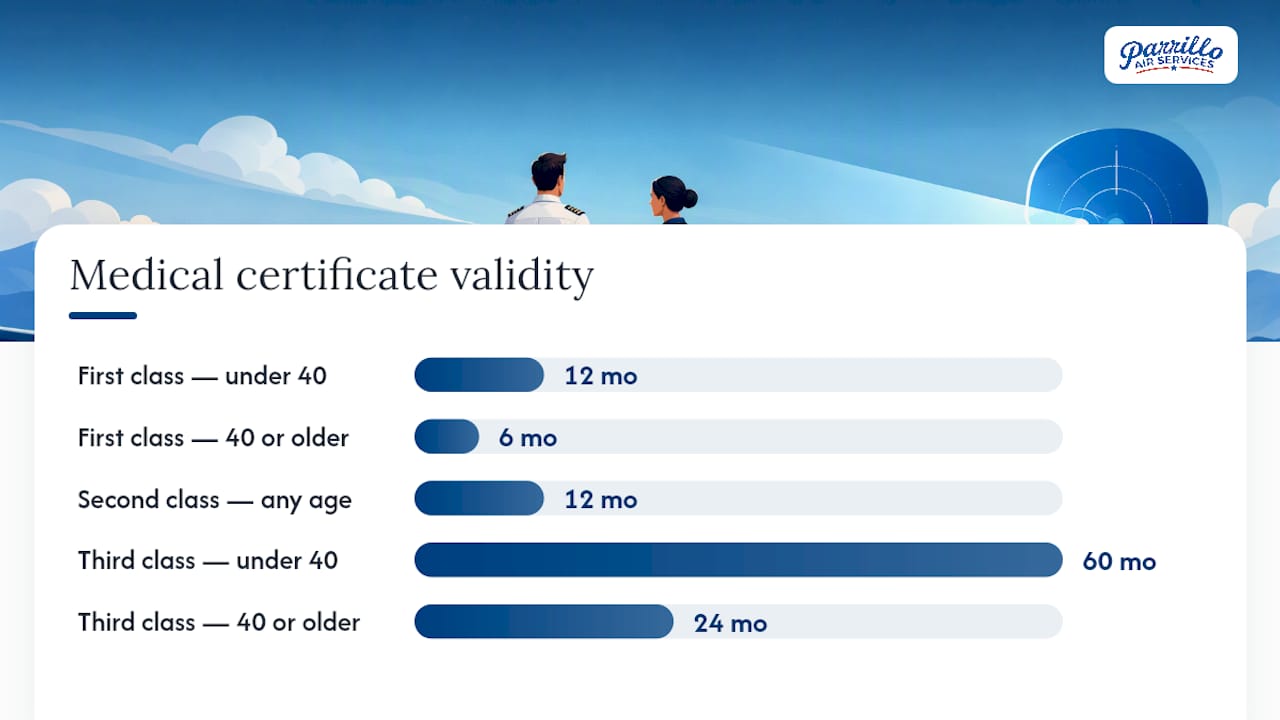
That means a 45 year old private pilot gets a fresh vision test every two years, while a 50 year old airline captain faces one every six months. There's no separate "vision only" recheck schedule that runs independently of your medical exam calendar. Whatever vision testing happens, happens at the same visit as your blood pressure check, cardiovascular review, and neurological screening.
One nuance worth knowing: intermediate vision testing (that 20/40 at 32 inches standard) only kicks in once you hit 50, so pilots under that age won't see it on their exam regardless of certificate class. If you're approaching 50, expect your next medical to include that additional check for the first time.
The FAA doesn't require pilots to report every minor vision fluctuation between exams, but a genuine change in your eye health is a different story. If you develop a condition that would have affected your last medical certification decision, such as a new diagnosis of glaucoma, a detached retina, or a significant prescription change that no longer corrects to standard, you're expected to address it before your next flight, not wait for your next scheduled medical.
Practically, this means two things. First, if a new limitation or condition arises and it's serious enough that it could affect your ability to safely operate an aircraft, you're required to ground yourself and consult your AME before flying again, similar to how you'd handle any other new medical condition. Second, at your next medical exam, you'll disclose the change on your MedXPress application (FAA Form 8500-8) under the relevant health history section, and bring supporting documentation, like an updated ophthalmology report or post-surgical clearance, so your AME has what's needed to make a determination on the spot rather than delaying your certificate.
Keeping a simple personal log of exam dates, prescription changes, and any ophthalmologist visits between medicals makes this process far smoother. It also protects you if a question ever comes up about when a condition was first identified.
Night vision doesn't get its own numeric standard the way distance and near acuity do, but it factors into FAA evaluation through two main channels: color vision testing and the operational limitations tied to it.
The logic is straightforward. Runway and taxiway lighting, air traffic signals, and cockpit displays all lean on color differentiation, and that differentiation matters more at night when ambient light disappears and pilots rely almost entirely on colored signals for spatial awareness. A pilot who can't reliably distinguish red from green in low light poses a real safety concern, which is exactly why color vision deficiencies that go unaddressed typically result in a night-flying restriction rather than a night-vision-specific test.
There's no separate low-light acuity chart or dark-adaptation test built into the standard FAA medical exam. Instead, the FAA's approach treats functional color perception as the proxy for safe night operation. Pass an alternative color test or the signal-light test, and the night restriction comes off your certificate entirely. Fail to pursue either option after a color vision screening failure, and you'll likely fly with a "not valid for night flying" limitation until you do.
This is a case where the regulatory approach favors demonstrated function over a lab measurement. Rather than measuring how well your eyes adapt to darkness in a clinical setting, the FAA asks you to prove you can identify the actual signals you'd encounter in the cockpit and on the ramp after sunset.
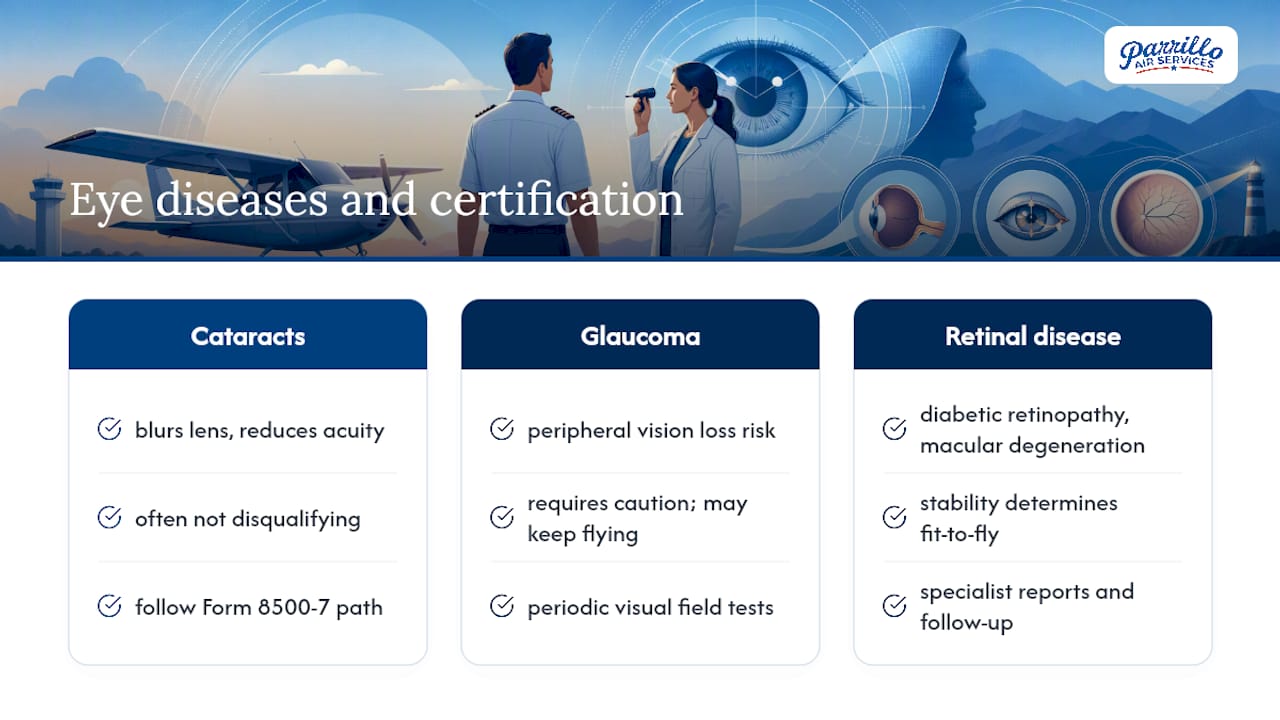
Certain eye diseases carry enough risk to cockpit safety that they trigger mandatory specialist involvement, though very few result in outright permanent disqualification when properly managed.
Cataracts cloud the eye's natural lens and progressively degrade visual acuity, contrast sensitivity, and night vision, sometimes before a pilot notices a dramatic drop on a standard eye chart. Early-stage cataracts often don't disqualify a pilot at all, since surgery is now routine and highly effective. Post-surgical pilots typically follow the same Form 8500-7 documentation path as refractive surgery patients, confirming stable, corrected vision before recertification.
Glaucoma is treated with more caution because it causes irreversible peripheral vision loss if intraocular pressure isn't controlled. A pilot with stable, well-managed glaucoma and normal visual fields can typically keep flying, often under a special issuance that requires periodic monitoring and updated visual field tests. Unstable or progressing glaucoma is a different matter, and it's one of the more common reasons an AME refers a pilot straight to an ophthalmologist rather than making a determination alone.
Retinal diseases, including diabetic retinopathy and macular degeneration, fall into a similar category. Stability and documentation drive the outcome far more than the diagnosis itself. A well-managed condition with clear specialist reports and periodic follow-up is compatible with continued certification in many cases, reflecting the FAA's broader emphasis on demonstrated function over categorical exclusion for chronic eye disease.
Vision standards are only one piece of the FAA medical puzzle, and getting them right the first time saves you from delays that can push back your entire training timeline. Parrillo Air Services works with student pilots throughout the Lynchburg, VA area to map out realistic paths toward private, instrument, and commercial certificates, including the medical readiness steps that come before you ever step into a cockpit.
If you're weighing whether your current prescription, a color vision concern, or a recent diagnosis might affect your certification, reach out to Parrillo Air Services to talk through your specific situation before you schedule your AME visit. A short conversation now can save you a rescheduled exam later.
Most articles on this topic either recite the numbers or scare readers with worst-case disqualification stories. Neither approach serves anyone. The actual regulatory pattern, once you read enough FAA guidance, favors documented function over rigid exclusion. A pilot with monocular vision, treated glaucoma, or a color deficiency has more realistic paths to certification today than the fear-driven advice floating around aviation forums suggests.
Where conventional advice falls short is timing. Too many pilots treat the AME visit as a pass-fail moment rather than a process they can prepare for months in advance. If you know you're color deficient, take the Ishihara test at home first and schedule your signal-light test before your medical, not after a surprise failure. If refractive surgery is on your radar, plan the 6 to 8 week healing window around your training schedule instead of discovering the conflict the week before a checkride.
The single biggest priority: treat your AME as a resource you brief, not an obstacle you hope to slip past. Bring documentation. Ask questions. The system rewards preparation far more than luck.
— Gm
Confirm every standard directly with the FAA's Guide for Aviation Medical Examiners for the numeric acuity requirements AMEs actually apply, and 14 CFR Part 67 §67.103 for the underlying regulation. The FAA's color vision page covers alternative tests and the signal-light procedure in detail. For a pilot-facing explanation of how these rules play out in practice, AOPA's guide to medical certification fills in the practical gaps between the regulation text and your actual AME visit.