
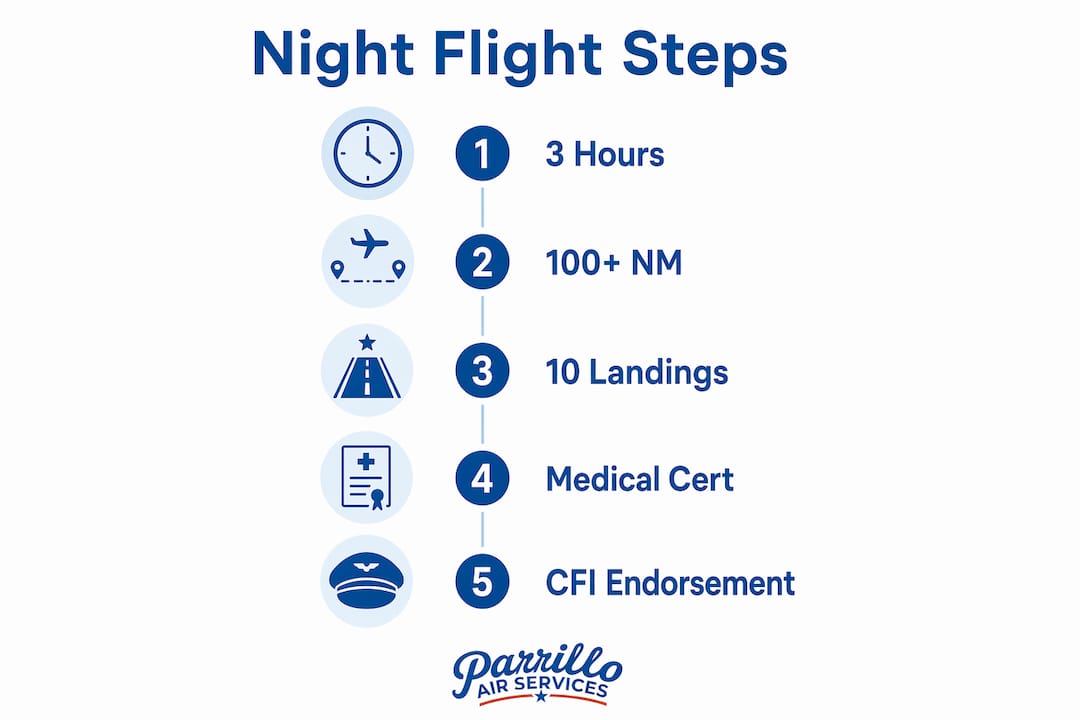
FAA night flight training requirements are the specific hours, maneuvers, and medical standards every student pilot must meet before flying legally after dark. Under 14 CFR § 61.109, the private pilot certificate demands at least 3 hours of night flight training, one cross-country flight exceeding 100 nautical miles, and 10 full-stop takeoffs and landings at night. These are not suggestions. They are the legal floor for night flying certification, and skipping or shortcutting any element means your certificate will carry a "Night flying prohibited" limitation. Understanding exactly what the FAA requires, and why each element exists, is the fastest path to a clean, unrestricted private pilot license.
The FAA defines night flight training requirements under 14 CFR § 61.109 for the private pilot certificate. Three distinct elements must be completed with an authorized flight instructor before you can log the hours toward certification.
Here is what the regulation mandates:
The cross-country requirement is not a simple out-and-back. The total route must exceed 100 nautical miles, and the flight must be completed at night from start to finish. This forces you to practice navigation, radio communication, and decision-making in low-visibility conditions before you ever fly solo after dark.
The takeoff and landing requirement carries a specific detail that many students miss. Per FAA night flight requirements, the 10 takeoffs and 10 full-stop landings must be performed in the traffic pattern at an airport with an operating control tower. Touch-and-go landings do not count. Full-stop means the aircraft comes to a complete stop on the runway before taxiing back for the next attempt.
| Requirement | Private Pilot (14 CFR § 61.109) | Commercial Pilot (14 CFR § 61.129) |
|---|---|---|
| Night flight hours | 3 hours minimum | 10 hours minimum (night VFR) |
| Cross-country at night | 100+ nm total distance | 100+ nm straight-line distance |
| Night takeoffs and landings | 10 full-stop in traffic pattern | 10 takeoffs and 10 landings |
| Instructor requirement | Authorized CFI | Authorized CFI |
Commercial pilot candidates face a significantly higher bar. Ten hours of night VFR flight time is required, and the cross-country standard is stricter. That gap between 3 hours and 10 hours reflects the FAA's expectation that commercial pilots operate in a wider range of conditions and carry passengers for compensation.
Medical certification for night flight is not the same as for daytime operations. The rules differ significantly depending on which pilot certificate you hold or are pursuing.
For private pilot students, a standard FAA Third Class Medical Certificate issued under 14 CFR Part 67 covers both day and night operations. BasicMed, the alternative medical pathway introduced in 2016, also permits night flying for private pilots operating under its limitations. Neither requires any additional night-specific medical exam.
Sport pilots face a different set of rules. Under Amendment 61-159, effective October 22, 2025, sport pilots gained expanded night flying privileges. However, the driver's license medical substitute that sport pilots use for daytime operations is invalid for night flight. Sport pilots who want to fly at night must hold either a Part 67 medical certificate or qualify under BasicMed. This is a hard regulatory line, not a gray area.
The endorsement process for sport pilots adds another layer. A sport pilot does not receive a single general night endorsement. Instead, sport pilot night endorsements are required separately for each category and class of aircraft the pilot intends to fly at night. If you fly a light sport airplane and a powered parachute, you need two separate endorsements.
For all pilot categories, an authorized Certificated Flight Instructor (CFI) must provide the required night training and sign off on the logbook before night solo or night PIC operations are legal.
Not every student pilot can complete night flight training on schedule. Geography creates real regulatory complications that the FAA addresses directly in 14 CFR § 61.110.
Alaska is the primary example. During summer months, continuous civil twilight means that legal night conditions, defined as the period beginning one hour after sunset and ending one hour before sunrise, may not occur for weeks. A student in Fairbanks, Alaska, cannot legally complete night training during those months because night never truly arrives.
The FAA's solution is a certificate limitation. Pilots who train in Alaska or certain island locations during continuous twilight periods can receive a private pilot certificate with the notation "Night flying prohibited" printed on the certificate. This is not a permanent disqualification. It is a temporary restriction that can be removed once the pilot completes the required night training in a location and season where legal night conditions exist.
Geographic exceptions demand early planning. A student who begins training in Alaska in spring and expects to certificate by summer may not be able to complete night requirements until fall. That delay can push back a commercial certificate timeline by months.
Key points for pilots training in affected areas:
The Alaska night flying exception is one of the few places where the FAA explicitly builds flexibility into the certification process. Use it strategically rather than letting it become a surprise obstacle.
Meeting the minimum hours is the starting point, not the finish line. Night flight training best practices center on risk management, and the FAA's own lesson plan guidance treats hazard identification as the core skill to develop.
Here are the most important practices to build from your first night lesson:
Fatigue compounds every night flying risk. Strategies used in shift-work environments, like those discussed in fatigue management research, apply directly to night pilots. Sleep debt, circadian disruption, and poor pre-flight nutrition all degrade judgment before you ever start the engine.
Night flight training is not a standalone module. It is woven into the broader flight training program from the private pilot level through commercial certification.
At the private pilot level, night training typically begins after a student has logged 15–20 hours of daytime dual instruction. The skills built during day training, radio communication, traffic pattern work, and cross-country navigation, all transfer directly to night operations. The difference is the reduced visual environment, which is why night training comes after a solid daytime foundation.
For commercial pilot candidates, the 10 hours of night VFR time builds on the private pilot foundation. Many students use instrument training, which runs concurrently with commercial training, to sharpen their scan and reduce reliance on outside visual references. That instrument proficiency pays dividends at night, when the horizon disappears and cockpit instruments become your primary reference.
Understanding the minimum flight hours required at each stage helps you plan your training budget and timeline realistically. Night training adds flight time, and flight time costs money. Knowing the requirements in advance prevents surprises.
FAA night flight training requirements mandate 3 hours of instruction, a 100-nautical-mile cross-country, and 10 full-stop night landings at a towered airport before a private pilot certificate is issued without restrictions.
| Point | Details |
|---|---|
| Core private pilot requirement | Complete 3 hours night training, one 100+ nm cross-country, and 10 full-stop landings in the traffic pattern. |
| Medical matters at night | Sport pilots need a Part 67 or BasicMed certificate for night PIC; a driver's license medical is not valid. |
| Geographic exceptions exist | Alaska pilots may receive a "Night flying prohibited" limitation, removable after completing training in legal night conditions. |
| Currency vs. proficiency | Three night landings in 90 days meets the legal standard; actual proficiency requires consistent practice beyond the minimum. |
| Commercial bar is higher | Commercial pilot candidates must log 10 hours of night VFR time, not the 3 hours required for private certification. |
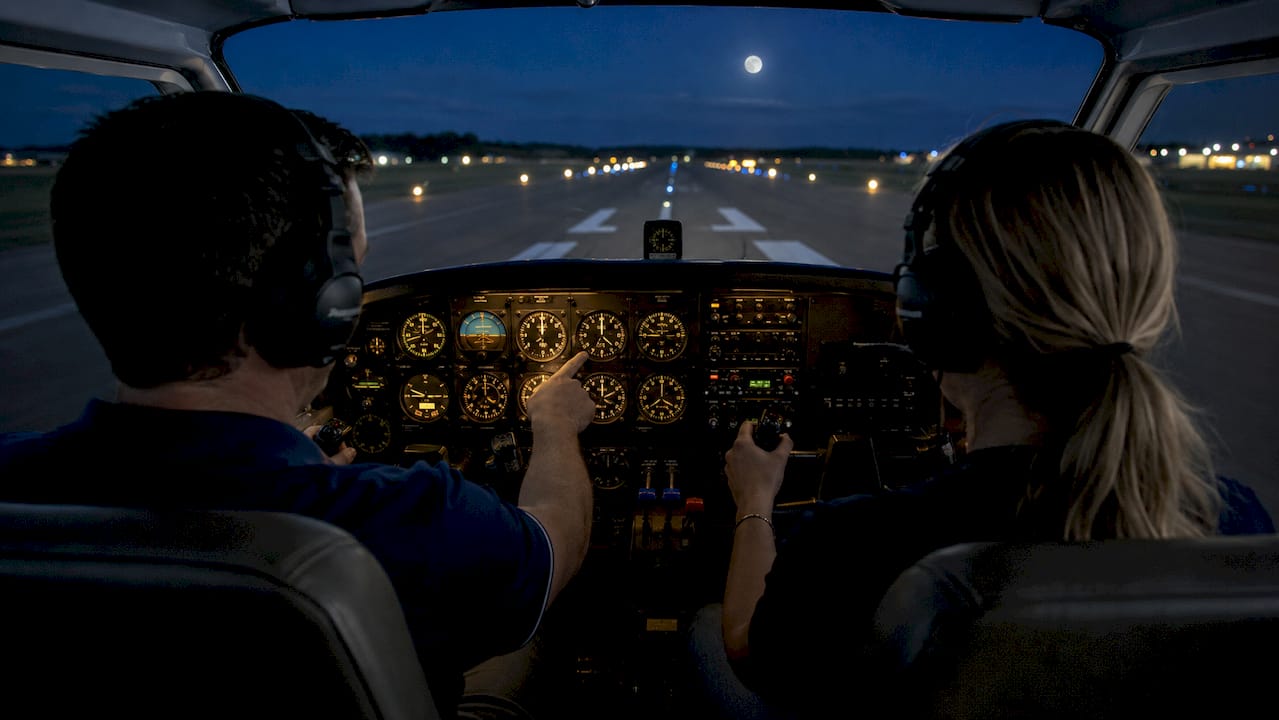
Most students treat night training as a box to check. Three hours, a cross-country, ten landings, done. That attitude is the wrong one, and I have seen it create real problems.
Night flying exposes every weakness in a pilot's instrument scan and situational awareness. The students who struggle most are the ones who coasted through daytime training relying on outside visual references. At night, that crutch disappears. Suddenly, the attitude indicator matters. The altimeter matters. The heading indicator matters. Students who built solid instrument habits during the day adapt quickly. Everyone else gets a hard lesson.
The spatial disorientation risk is not theoretical. It is the mechanism behind a significant number of fatal general aviation accidents. The FAA's emphasis on risk management in night training lesson plans exists because the hazard is real and well-documented.
My honest advice: treat your 3 required hours as the minimum, not the goal. Ask your CFI for additional night dual instruction before your first solo night flight. Practice the cross-country route in daylight first so the landmarks are familiar. Fly the traffic pattern at night until the VASI lights feel as natural as the runway numbers do during the day.
Night flying is genuinely rewarding. The air is smoother, the radio is quieter, and the view from altitude is unlike anything you experience during the day. But that reward comes to pilots who prepare seriously, not to those who rush through the requirement.
— Gm
Parrillo Air Services, based in Lynchburg, VA, offers FAA Part 61 flight training built around personalized instruction and real-world preparation. Night flight training is integrated into every private pilot program, with CFIs who understand both the regulatory requirements and the practical skills that make night operations safe.

Whether you are starting from zero or working toward your commercial certificate, the team at Parrillo Air Services structures training around your schedule and your goals. Night cross-countries, traffic pattern work, and risk management are all part of the curriculum, not afterthoughts. Get the details on flight training programs and find out how Parrillo Air Services can help you meet every FAA night requirement with confidence.
Whether you're ready to schedule a discovery flight or just want to ask a few questions, Parrillo Air Services in VA is here to help you move from curious to certificated.
Get in Touch TodayThe FAA requires 3 hours of night flight training for a private pilot certificate under 14 CFR § 61.109. This must include one cross-country flight over 100 nautical miles and 10 full-stop takeoffs and landings at night.
The FAA defines night as the period beginning one hour after sunset and ending one hour before sunrise. Flight time logged outside this window does not count toward night flight training requirements.
Yes, but only with additional training and a qualifying medical certificate. Amendment 61-159, effective October 22, 2025, expanded sport pilot night privileges, but a driver's license medical substitute is not valid for night PIC operations.
Pilots who train in Alaska during continuous civil twilight may receive a private pilot certificate with a "Night flying prohibited" limitation. This restriction is removed after completing the required night training in a location where legal night conditions exist.
To carry passengers at night, you must have completed three takeoffs and three full-stop landings at night within the preceding 90 days, per 14 CFR § 61.57. Currency is the legal standard; consistent practice is what keeps you actually proficient.