
The FAA requires full, accurate disclosure of every past and current medical condition, surgery, hospitalization, psychiatric history, substance use episode, and medication on FAA Form 8500-8 (completed through MedXPress). An Aviation Medical Examiner (AME) will review that history face-to-face and may request formal Clinical Progress Notes or other supporting records before issuing your certificate. Understanding what FAA medical history requires is the difference between walking out with a certificate and getting deferred.
Before your AME appointment, have these ready:
Pro Tip: If a condition was previously reported and nothing has changed, write "PREVIOUSLY REPORTED, NO CHANGE" in the MedXPress explanation box. You still check "yes" to the condition — but you avoid retyping a full history while staying completely truthful.
MedXPress collects Items 1 through 20 of FAA Form 8500-8 online and produces a confirmation number the AME imports at your appointment. The medical history section is Item 18, and it covers every condition you have ever been diagnosed with, currently have, or have had at any point in your life. There is no statute of limitations on disclosure.
Item 18 runs from 18.a through 18.y and covers:
Item 17 asks separately whether you currently use any prescription or nonprescription medication. Item 19 asks about visits to any health professional within the last three years, including physicians, physician assistants, psychologists, and clinical social workers — for any reason related to a personal medical or mental health condition.
Common mistakes that trigger record requests: vague entries like "heart issue, 2019" with no diagnosis, missing medication names or doses, and incomplete dates. The AME is required to review your history page before beginning the physical exam and will ask follow-up questions on anything that looks incomplete.

Pro Tip: MedXPress is a screening tool, not the final word. The in-person AME conversation is where immediate issuance is actually decided. Arrive knowing your dates, diagnoses, and treating clinicians' names.
The records you need depend on what you disclosed. Here is the core document set and typical recency expectations:
| Document Type | What the FAA Needs | Typical Recency |
|---|---|---|
| Clinical Progress Note | Objective findings, diagnosis, treatment plan, clinician contact info | Often within 90 days for active conditions |
| Operative / surgical report | Procedure details, pathology, recovery status | Full report; no expiration if stable |
| Hospital discharge summary | Admission diagnosis, treatment, discharge status | Full report; no expiration if stable |
| Specialist consult note | Assessment, recommendations, follow-up plan | Within 90 days if condition is ongoing |
| ECG (electrocardiogram) | Rhythm, intervals, interpretation | No earlier than several weeks before application (first-class, age-specific rules apply) |
| EEG | Baseline and follow-up tracings with interpretation | Per neurologist's recommendation; FAA specifies timing |
| Diagnostic imaging reports | Radiology read with clinical correlation | Per condition; most recent study |
| Lab results | Relevant panels (HbA1c, lipids, etc.) | Within 90 days for metabolic conditions |
| Sleep study (polysomnography) | AHI, CPAP compliance data if applicable | Most recent; compliance data current |
Per 14 C.F.R. part 67, the FAA sets medical standards for neurological, cardiovascular, mental health, and general medical conditions. An ECG is required at first application after age 35 for first-class certificates and annually after age 40 for first-class applicants.
What the AME can handle in-office vs. what goes to the FAA:
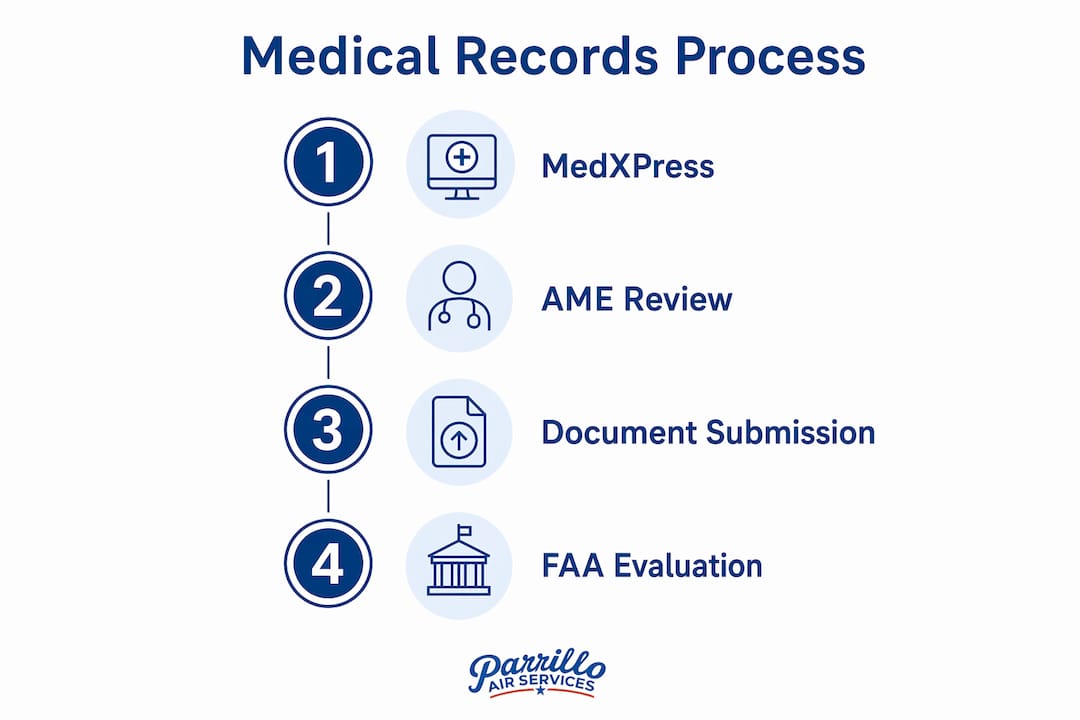
The AME imports your MedXPress confirmation at the start of the appointment. That pulls your completed Form 8500-8 into the Report of Medical Examination, which the AME signs and transmits to the FAA after the exam.
If additional records are needed, you may be asked to sign a Medical Records Request or release authorization. That consent allows the FAA or AME to contact your treating clinicians directly. Under §67.413 of 14 C.F.R. part 67, you are required to furnish requested medical information or authorize its release. Refusing is not a neutral act — it can result in denial, suspension, or revocation.
Submission paths:
Timeline reality: If the AME issues your certificate on the spot, you leave with it that day. If the AME defers, FAA review adds weeks to the process — sometimes longer for complex cases or special issuance requests. Arriving with complete, organized records is the single most reliable way to avoid deferral.
Pro Tip: Call the AMCD or check faa.gov for current submission address and preferred format (PDF is standard). Include your full name, date of birth, and FAA Airman Inquiry number on every page of supplemental records.
Privacy note: The FAA's access to your records is limited to what is necessary for certification. Your authorization does not open your entire medical history to the public — it allows the FAA to request and review records relevant to the conditions you disclosed.
Some conditions almost always prompt the AME to request additional documentation before issuing or to defer to the FAA. Knowing which records to gather in advance can convert a likely deferral into same-day issuance.
| Condition | Records Typically Requested | Key FAA Expectation |
|---|---|---|
| Coronary artery disease / MI | Cardiology consult, stress test, ECG, cath report, discharge summary | Evidence of stable function; stress test recency per FAA cardiac protocol |
| Hypertension requiring medication | Treating physician note, current medication list, BP log | Stable control; approved medications only |
| Seizure / epilepsy / LOC | Neurology consult, EEG, MRI/CT, treatment summary | Two-year seizure-free period often required; case-by-case |
| Psychiatric diagnosis (depression, anxiety, bipolar, psychosis) | Psychiatry/psychology treatment summary, medication history | Stability, no disqualifying medications; HIMS AME often required |
| Substance dependence | Treatment records, urine drug screen, sponsor letters | Typically two years of documented sobriety for alcohol dependence |
| Diabetes (medication-controlled) | Endocrinology note, HbA1c, medication list | Insulin use is disqualifying for most classes without special issuance |
| Sleep apnea | Polysomnography, CPAP compliance data | Documented compliance; AHI and treatment response |
Proactive record gathering for these conditions:
Pro Tip: When requesting a Clinical Progress Note, tell your clinician explicitly: "I need a formal Clinical Progress Note for an FAA medical exam — not an After Visit Summary. Please include your objective findings, current diagnosis, treatment plan, and your contact information." That single sentence prevents the most common record-quality problem.
Follow this sequence in the 1–2 weeks before your AME appointment:
Why After Visit Summaries fall short: FAA guidance specifically warns that patient-portal AVS documents commonly lack the diagnostic detail, clinical assessment, and treatment plan the FAA needs for adjudication. A Clinical Progress Note contains objective findings, a formal assessment, a treatment plan, and the clinician's contact information. An AVS typically contains none of that.
Sample request text for your clinician:
If the MedXPress explanation box is too short for a complex history, submit a separate supplemental document with your full name, date of birth, exam date, FAA PI/MID or confirmation number, and your signature and date. That ensures the FAA attaches it correctly to your file.
Pro Tip: Request records as a PDF. Include the clinician's phone number on the document itself. If the AME or FAA needs a quick clarification, a direct call to your doctor can resolve a question in minutes rather than triggering a formal deferral.
The consequences are serious and they escalate quickly.
Administrative and regulatory consequences:
Practical consequences:
The protective case for full disclosure is straightforward. Timely, complete disclosure paired with solid clinical documentation gives the AME and the FAA what they need to make a favorable determination quickly. Concealment, by contrast, creates a record problem that can follow you through every future application. Regional airline hiring standards, for example, include a review of your medical certification history — a pattern of deferrals or a falsification finding has real career consequences beyond the certificate itself.
The single most important step before any FAA medical exam is requesting formal Clinical Progress Notes from every treating clinician — not portal summaries, not discharge papers alone, but signed, dated progress notes with objective findings and a treatment plan.
| Point | Details |
|---|---|
| MedXPress covers your full history | Item 18 requires disclosure of every condition ever diagnosed, with no time limit on past history. |
| Clinical Progress Notes are required | AVS portal summaries are usually insufficient; request formal notes with objective findings and treatment plans. |
| AME review determines issuance | The in-person AME conversation, not MedXPress alone, decides whether you leave with a certificate that day. |
| Withholding records has legal consequences | Under §67.413, refusing to furnish requested records can result in suspension or revocation of your certificate. |
| Parrillo Air Services guides your path | Parrillo Air Services helps aspiring pilots time their medical exam and training enrollment for a clear path to certification. |
Pre-exam checklist by condition:
Most pilots treat the FAA medical as a physical, but appreciating continuous monitoring and safety protocols similar to how one might vet a drone cleaning contractor can improve your preparation and outcome. It is not. The physical takes 20 minutes. The history review, the documentation check, and the AME's judgment call on whether to issue or defer — that is where the outcome is decided.
The applicants who sail through are not necessarily the healthiest. They are the most organized. They arrive with a one-page summary of their conditions, dates, and treatments. They have their clinicians' phone numbers on the packet. They have already requested Clinical Progress Notes, not portal printouts. When the AME asks a follow-up question, they have the answer on paper.
What most people underestimate is how much the AME wants to issue the certificate. Deferring creates work for everyone. If you hand the AME everything needed to verify stability or resolution on the spot, the default outcome is issuance. The deferral happens when something is missing, not when something is disclosed.
The one thing worth saying plainly: do not omit a condition because you think it will disqualify you. Many conditions that look disqualifying on paper are certifiable with the right documentation and, in some cases, a special issuance. The pilot medical certification process exists to keep aviation safe, not to screen out everyone with a medical history. Treat it as a documentation task, prepare accordingly, and let the AME do their job.
Getting your medical certificate is the first concrete step toward a pilot career, and the documentation work that precedes it is exactly the kind of preparation Parrillo Air Services helps students navigate. Based in Lynchburg, VA, Parrillo Air Services offers FAA Part 61 flight training from discovery flights through commercial and flight instructor certifications, with personalized scheduling that accounts for where you are in the certification process — including timing your training around your medical exam.

If you are working through the medical history process and want to understand how it connects to your full training timeline, the team at Parrillo Air Services can walk you through the steps. Whether you are pursuing a private pilot certificate or planning a career path toward regional airlines, your medical certificate is the foundation everything else is built on. Visit Parrillo Air Services flight training programs to learn more about enrollment, scheduling, and what to expect at each stage of your certification.