
There are three FAA medical certificate classes: First, Second, and Third, and each one unlocks a different level of flying privilege. Most aspiring pilots starting flight training only need a Third-class medical, the entry point for student, recreational, and private pilots. Your first move is simple: create an account on MedXPress and schedule your exam with an FAA-designated Aviation Medical Examiner.
TL;DR:
- Most pilots start with a Third-class medical, which is valid for 60 months under 40 and 24 months after 40, depending on age.
- Applying through MedXPress and scheduling an exam with an FAA-designated AME streamlines the process and reduces wait times.
- Certain conditions like epilepsy, insulin-dependent diabetes, or recent cardiac events require close review or special programs like HIMS.
- Preparing documentation, medications, and recent tests before the appointment minimizes delays and ensures a smooth exam.
- Scheduling your medical before beginning flight training prevents delays that can stall progress toward certifications or licenses.
The FAA doesn't assign your medical class based on the certificate hanging on your wall. It assigns it based on the flying you actually plan to do. An airline transport pilot who only flies for fun on weekends might only need a Third-class medical, while someone chasing an ATP career needs the most rigorous exam the FAA offers.
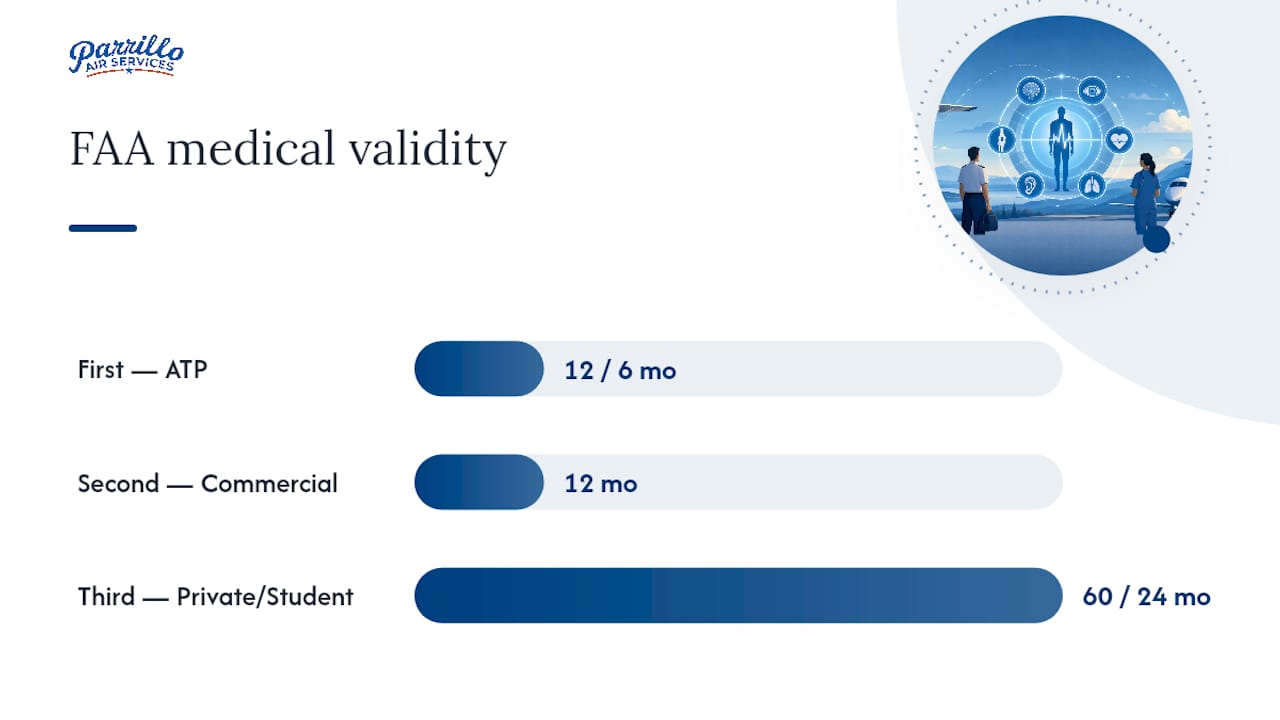
First-class certificates cover Airline Transport Pilot (ATP) privileges, the credential you need to fly for a regional or major airline. Second-class certificates support commercial pilot operations, think charter flying, aerial survey work, or flight instruction for pay. Third-class certificates cover student, recreational, and private pilot privileges, which is where most people reading this article will land first.
Validity periods hinge on both class and age, and the age 40 cutoff catches a lot of pilots off guard. A Third-class medical lasts 60 months if you're under 40 on the exam date, but only 24 months once you hit 40. First-class certificates last 12 months under 40, dropping to just 6 months for pilots 40 and older exercising ATP privileges. Second-class certificates run 12 months regardless of age for commercial operations.
| Class | Who Needs It | Validity Under 40 | Validity 40+ |
|---|---|---|---|
| First | ATP / airline pilots | 12 months | 6 months (ATP privileges) |
| Second | Commercial pilots | 12 months | 12 months |
| Third | Student, recreational, private pilots | 60 months | 24 months |
If you're eyeing an ATP certification path, it's worth understanding early that your medical requirements will get stricter as your training advances, not just your flight hours.
The application process has a specific order, and skipping the first step is the single most common reason applicants waste time sitting in an AME's waiting room.
Completing Form 8500-8 through MedXPress before you walk in matters more than most first-timers realize. Because the AME can pull your submitted data electronically, the office visit runs noticeably faster than it would if you were filling out paperwork in the waiting room.
The exam itself typically covers:
Most applicants walk out with a certificate in hand the same day. If your file gets flagged for additional review, expect a wait measured in weeks rather than months, depending on how much documentation the FAA's Aerospace Medical Certification Division needs from you.
The FAA doesn't evaluate pilots on a whim. 14 CFR Part 67 spells out the exact medical standards for each class, covering vision, ENT and equilibrium, mental health, neurologic function, cardiovascular health, and a catchall "general medical condition" clause that gives AMEs room to flag anything unusual.
Certain conditions almost always trigger a closer look rather than an automatic denial:
Pro Tip: Don't assume a diagnosis is automatically disqualifying. The FAA's discretionary issuance process, overseen by the Federal Air Surgeon, has cleared thousands of pilots with conditions that sound scary on paper but are well managed in practice.
For first-class applicants, Part 67 also requires an EKG starting at age 35, then annually after 40, a detail that catches career-track pilots off guard if nobody warns them ahead of time.

If you have a history of substance misuse or certain psychiatric conditions, a standard AME visit isn't the right starting point. The FAA's HIMS program connects pilots with specially trained HIMS AMEs who manage monitoring, sponsorship, and structured return-to-flying plans that a general AME can't authorize.
Pro Tip: If you're unsure whether your history qualifies as reportable, ask a HIMS-trained AME before you submit MedXPress. That one conversation can save you months of delay.
Separately, remember your obligation under 14 CFR 61.53 to self-ground if you know of a medical deficiency or you're on medication that could impair safe flight, regardless of whether your certificate is technically still valid.
A little prep work turns a stressful appointment into a formality. Most delays trace back to missing paperwork, not failed exams.
Pro Tip: AME fees vary by provider and by class of exam, so call ahead and ask for the exact cost before you book. It's a small step that avoids an awkward surprise at checkout.
Plan on the appointment itself taking under an hour if your MedXPress form is complete. Add a few weeks of buffer if your case needs review beyond the AME's office, particularly for special issuances tied to Part 67 conditions.
The biggest mistake we see is students who wait until after their first few lessons to schedule a medical, then discover a Third-class certificate takes longer than expected because of an undisclosed condition. Get your medical squared away before, or alongside, your first discovery flight. At Parrillo Air Services, we build medical readiness into the earliest stages of training planning, not as an afterthought once you're already logging hours toward your student pilot certificate.
— Gm
Parrillo Air Services runs FAA Part 61 flight training out of Lynchburg, Virginia, covering everything from your first discovery flight through private pilot, instrument, commercial, and flight instructor certification, with flexible scheduling built around your life and, for Liberty University students, credit transfer support along the way.

We're not an AME, and we don't issue medical certificates. What we do is help you sequence your medical paperwork with your training calendar so a delayed exam never stalls your progress toward a commercial pilot certificate or airline career. If you're ready to see what your training timeline could look like, schedule a discovery flight with Parrillo Air Services and let's map out your path together.
Get in Touch TodayEverything in this guide traces back to official FAA sources, and you should bookmark these before you start your application:
Use the AME guide to confirm which class applies to your goals, the certification hub to start your MedXPress application and find an examiner near you, and Part 67 if you want the exact regulatory language behind a specific medical standard.
This article is general information, not a substitute for advice from a qualified doctor. Consult a qualified healthcare professional about your own circumstances before acting on anything here.