A private pilot training syllabus is a structured, stage-by-stage flight and ground training plan built to get you from your first lesson to a passed FAA practical test. It must cover eligibility rules, minimum flight hours and required tasks, staged lesson objectives with completion standards, a scheduled knowledge test, and checkride preparation aligned to the Airman Certification Standards. A legally minimal syllabus and a realistic one aren't the same thing. Plan for more hours than the regulatory floor.
TL;DR:
Most FAA-compliant syllabi break training into three stages, each ending with a review or stage check before you move forward. This mirrors the structure used in approved Part 141 training programs and shows up in published examples like the University of Oklahoma's private pilot syllabus and ASA's Complete Private Pilot Syllabus. If you're wondering what a training syllabus pilot program actually looks like day to day, this is it.
Stage 1: Fundamentals and first solo. You'll spend this stage on aircraft control, radio communication, traffic pattern work, and basic maneuvers like slow flight, stalls, and steep turns. The stage ends with a pre-solo written exam and a stage check where an instructor confirms you can safely operate the aircraft alone in the pattern. Sample syllabi typically budget 15 to 20 flight hours for this stage, though some students solo faster and others need extra pattern work before an instructor signs them off.
Stage 2: Cross-country and night operations. Once you've soloed, training shifts toward navigation, pilotage, dead reckoning, and eventually GPS-based cross-country flying. You'll log required solo cross-country time, complete night flight training including a night cross-country, and start working on more advanced maneuvers like emergency procedures and simulated instrument flight. This stage often runs another 15 to 20 hours and typically ends with a second stage check that verifies cross-country planning skills and instrument-reference competency.
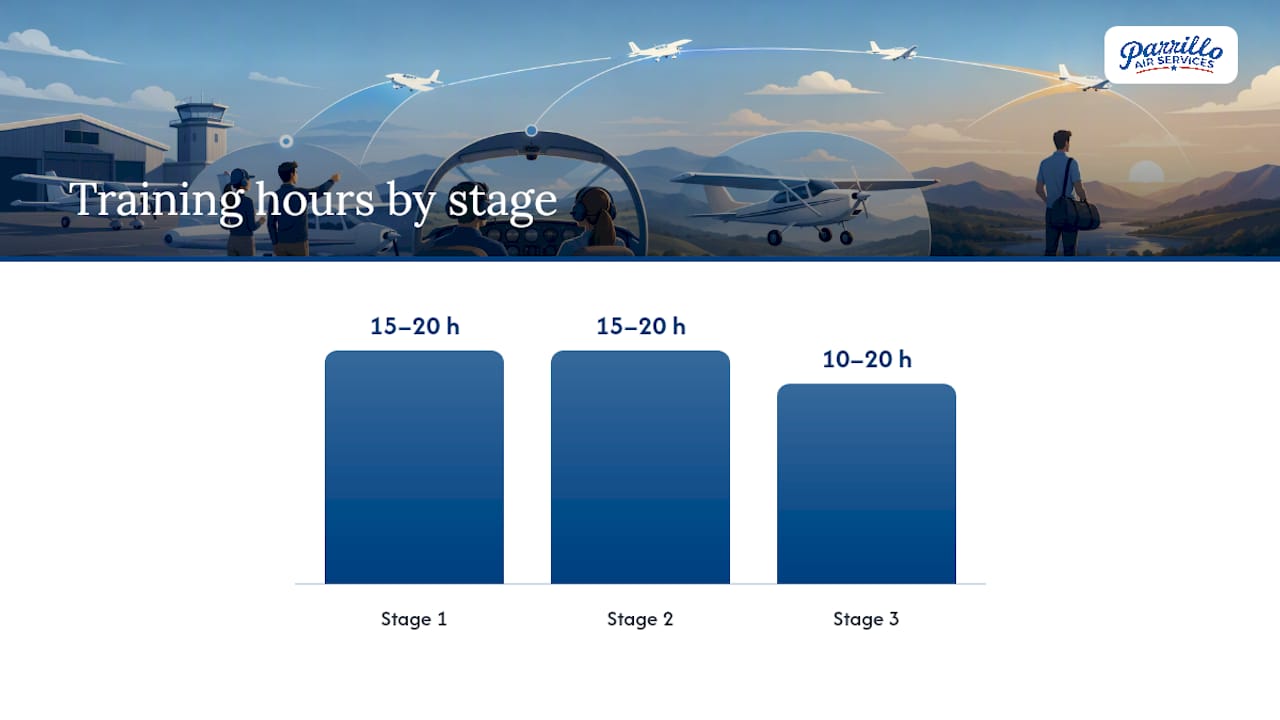
Stage 3: Advanced cross-country and checkride prep. The final stage sharpens everything: longer cross-country legs, night operations refinement, and maneuver polish to Airman Certification Standards tolerances. This is where mock oral exams and full practical-test simulations happen. Expect 10 to 20 additional hours depending on how much correction is needed and how your instructor structures the final stage check.
A typical stage breakdown looks something like this:
Part 61 programs, which don't require FAA-approved stage checks, sometimes fold these into fewer formal breakpoints. Part 141 programs are required to document specific stage-check items per Appendix B, so their syllabi tend to look more granular on paper even when the actual flying is similar.
Before any syllabus is worth following, it needs to meet the regulatory floor the FAA sets for private pilot certification. This isn't optional structure. It's the baseline every approved course, whether Part 61 or Part 141, has to build around.
Eligibility comes first. You must be at least 17 years old to hold a private pilot certificate, though you can solo at 16. Candidates need to read, speak, write, and understand English, and generally need at least a third-class medical certificate before that first solo flight.
Part 61 vs. Part 141 changes the hour count. Part 61 training requires a 40-hour minimum with no mandated ground-training hours, which gives instructors more flexibility to adapt to an individual student's pace. Approved Part 141 courses, by contrast, follow Appendix B's prescribed curriculum, which sets a 35-hour flight minimum alongside specific ground training requirements. Both paths require the same core flight elements: solo time, a solo cross-country, night flight with a night cross-country, and instrument-reference maneuvers.
Pro Tip: Neither 40 nor 35 hours is a real-world target. Both are legal floors. Treat them as the minimum you'd need under ideal conditions, not a number to plan your budget around.
The Airman Certification Standards define exactly which tasks you need to demonstrate and to what tolerance, from altitude control during steep turns to landing performance calculations. A well-built syllabus maps every lesson back to specific ACS codes, so by the time you reach the practical test, nothing on the exam is unfamiliar.
Regulatory minimums make for a clean headline, but they rarely match reality. Most students need roughly 60 to 75 total flight hours to reach checkride readiness, not the 35 or 40 hours quoted as the legal floor. Weather delays, scheduling gaps, and normal skill-building account for the difference.
How you pace those hours matters as much as how many you fly. Three realistic timelines:
Pro Tip: If your lessons are spaced more than a week apart, ask your instructor to spend the first ten minutes of each flight reviewing the last lesson's maneuvers before moving forward. It costs a little time up front but prevents relearning the same skill twice.
Flying two to three times a week consistently reduces skill fade and tends to shorten overall training time compared with sporadic scheduling. It's the single biggest lever a student actually controls, since weather and aircraft availability aren't always up to you.
Budgeting ground time matters too. Basic aviation training devices can substitute for a portion of instrument-reference time and cost far less per hour than aircraft rental, making them a smart way to build procedural fluency without burning flight budget on repetition you could practice on the ground. Check realistic hour expectations against your own schedule before committing to a timeline.
The FAA private pilot knowledge test is 60 multiple-choice questions with 2.5 hours allotted, and you need a 70% score to pass.
Most syllabi schedule the knowledge test around the midpoint of Stage 2, after cross-country planning concepts have been introduced but before the final stage check. That timing means ground school knowledge reinforces the cross-country flying you're doing simultaneously, rather than sitting isolated as pure memorization. The EAA's guidance on becoming a private pilot backs this approach, recommending integrated, scenario-based study over rote fact recall.
Treating the written exam as scenario-based preparation, working through real cross-country planning problems and weather decision scenarios instead of flashcard memorization, produces better retention and translates directly into stronger performance during the oral portion of the checkride.
A practical prep checklist looks like this:
Working through a full checkride preparation checklist a few weeks out from your test date catches gaps while there's still time to fix them.
A syllabus is only as good as how it's applied day to day. At Parrillo Air Services, instruction stays personalized rather than following a rigid classroom pace, which means lesson sequencing can shift based on how quickly a student masters each objective rather than forcing everyone through identical timing.
A few habits consistently separate efficient students from ones who stall out:
The most common source of delay isn't weather. It's scheduling gaps that let skills go stale between lessons, forcing instructors to re-teach material instead of building on it. Before endorsing a student for solo or a final stage check, instructors want to see each required maneuver performed to ACS tolerances consistently, not just once.
Pro Tip: If you notice the same correction coming up flight after flight, flag it to your instructor directly. A pattern like that usually means a five-minute conceptual fix on the ground will save hours of repeated practice in the air.
Instructors adjust pacing based on where a student is headed. A career-track student aiming at the airlines benefits from earlier exposure to instrument concepts and disciplined cross-country planning, since those skills carry forward directly. A recreational pilot might spend more time on stick-and-rudder proficiency and less on formal cross-country structure.
Either way, safety and consistent, repeatable proficiency matter more than chasing a specific hour count. Track your progress through stage-check competencies rather than watching the hour meter, and the certificate follows naturally.
— Gm
You don't have to build a syllabus from scratch or piece one together from scattered PDFs. Parrillo Air Services runs FAA Part 61 training in Lynchburg, Virginia, structured around the same staged approach covered above, with instruction that adapts to your pace instead of forcing you through a fixed classroom schedule.

If you're not sure flying is for you yet, the Discovery Flight is an introductory flight with an instructor, with no long-term commitment required. Ready students move into the full Private Pilot Certificate program, with aircraft rental and instruction billed hourly so you always know what you're paying for, detailed on the rates and fees page. Limited enrollment means more access to instructors and aircraft, and flexible scheduling means your training plan bends around your job or school, not the other way around. Book a discovery flight or request a detailed course plan to see exactly how this syllabus maps to your timeline.