A high-performance airplane has an engine rated above 200 horsepower. A complex airplane has retractable landing gear, flaps, and a controllable-pitch propeller. Some airplanes, like many Beechcraft Bonanzas, require both. Each is a separate, one-time logbook endorsement you earn through ground and flight training with an authorized instructor, not a written test.
The FAA doesn't leave these definitions open to interpretation. Under 14 CFR, a high-performance airplane is one with an engine rated for more than 200 horsepower. Not 200 exactly. Over it. A Cessna 182 with a 230-horsepower engine qualifies; a hypothetical airplane sitting at precisely 200 horsepower does not, according to AOPA's guidance on transitioning to high-performance airplanes.
A complex airplane requires three features working together, not just one:
Seaplanes get a carve-out here. Since retractable gear doesn't apply the same way to floats, the FAA drops that requirement for seaplanes and bases the complex determination on flaps and prop control alone.
This structure dates to a 1997 regulatory overhaul that split what used to be one murkier category into two distinct endorsements. Pilots who logged qualifying pilot-in-command time in these airplane types before August 4, 1997, may be grandfathered in under the older rules, according to AOPA. If your logbook goes back that far, that history matters more than you might think.
Here's the part that surprises a lot of student pilots: there's no minimum flight-hour requirement written anywhere in the regulations for either endorsement. You won't find a rule that says "10 hours of complex time" or "5 hours of high-performance training." Instead, the standard is proficiency, verified by an instructor.
The process breaks down into three steps:
AC 61-65 provides sample language for that entry, something close to: "I certify that [name] has received the training required by 61.31(e)/(f) in a [make/model] and has been found proficient." Representative flight training devices can count toward this training too, provided the device genuinely reflects the airplane's systems and handling.
Treat this like a mini-syllabus, not a checklist you rush through in an afternoon. A structured approach to earning your endorsement tends to produce pilots who actually retain the skills instead of just collecting a signature.
Ground school topics to nail down first:
Flight syllabus, roughly in order:
Simulators and FTDs can shoulder some of this load, especially for procedures you don't want to practice for the first time at 500 feet. But an instructor still has to judge the device as representative of the airplane before that time counts meaningfully toward proficiency. Ask your CFI to specify, in writing, which maneuvers you completed in the device versus the airplane. When you're ready for the sign-off, ask directly: "What specifically are you certifying with this endorsement, and what would make you hesitate to sign it?" That question tends to surface any gaps before they become a problem in the airplane.
Model names get thrown around loosely in hangar talk, so it helps to know the pattern before you assume anything about a specific tail number.
Don't take any of this as gospel for the specific airplane you're about to fly. Model year, engine swaps, and STC modifications change the picture. A high-performance endorsement that applied to a 1975 model year might not apply to a later variant with a different engine installed. Check the Type Certificate Data Sheet or the airplane's own POH for the installed engine's actual horsepower rating before you assume anything.
The endorsement is a formality. What it's supposed to represent is a real jump in workload, and that jump catches people off guard even when they've done everything on paper correctly.
Retractable gear and constant-speed props add tasks to every phase of flight that a fixed-gear trainer never demanded. You're now managing gear position on every pattern, monitoring prop RPM independent of throttle, and watching manifold pressure limits that didn't exist in a Cessna 172. High-performance engines compound this with faster airspeeds, quicker power changes, and less margin for a delayed decision. The Airplane Flying Handbook is direct about this: both complexity and performance increase pilot workload, and the handbook recommends structured, syllabus-based training precisely because ad hoc familiarization tends to leave gaps.
Rehearse these before you consider yourself proficient, not just competent enough to pass:
Staged training works better than trying to absorb everything in one flight. Master configuration changes first, then layer in abnormal procedures, then combine both under time pressure with a CFI running scenarios you didn't expect.
The regulatory definitions tell you what boxes an airplane checks. They don't tell you what it's like to fly one, and that gap is where a lot of transitioning pilots get surprised.
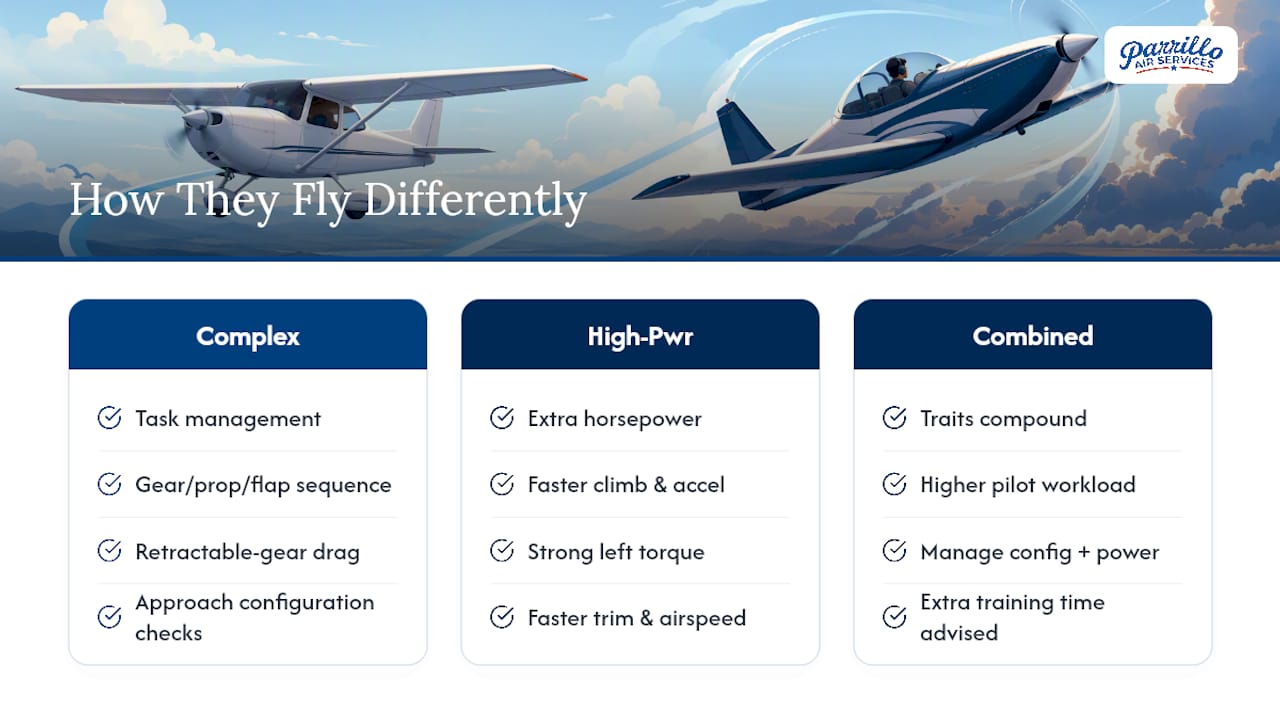
A high-performance airplane's extra horsepower shows up everywhere: faster climb rates, quicker acceleration on takeoff roll, and more torque effect that pulls the nose left on a hard power application. You'll notice trim changes happen faster and airspeed builds quicker than you're used to, which shrinks your reaction window during critical phases like takeoff and go-around.
A complex airplane's challenge is different. It's not raw power, it's task management. Every approach now includes a gear-down checkpoint, a prop-pitch decision, and flap timing that all have to happen in sequence without skipping a step. Retractable gear also changes your glide performance if you're not careful. Gear-down drag is real, and forgetting to account for it on a power-off approach will put you short of the runway.
When an airplane stacks both traits, like many Bonanzas do, the two challenges compound rather than simply add together. You're managing configuration and handling high power simultaneously, which is exactly why instructors treat these as the most demanding step-up airplanes short of turbine transition training. The practical impact: don't assume that acing your complex endorsement in a Piper Arrow means a high-performance Bonanza will feel familiar. Budget extra training time for that combination, not less.
Picture three different students, each hitting this requirement for a different reason.
The first is finishing a private pilot certificate and wants to rent a Cessna 182 for a mountain trip because the extra horsepower gives better climb performance at altitude. That's a high-performance-only situation. No retractable gear involved, so the complex endorsement never enters the conversation.
The second is building hours toward a commercial certificate and needs complex airplane time specifically, since the commercial checkride historically required it for single-engine applicants in many training tracks. A Piper Arrow rental checks that box efficiently without the added cost of a high-horsepower engine.
The third is a career-track student, maybe eyeing a Liberty University credit pathway or a similar structured program, who wants to fly a Bonanza for cross-country efficiency. That student needs both endorsements before the insurance company or the rental outfit hands over the keys, and realistically should treat the combined training as its own distinct block of instruction rather than two quick add-ons.
None of these scenarios are exotic. They're the normal decision points that come up as a pilot's mission profile changes, whether that mission is a weekend trip, a certificate requirement, or a career milestone. The endorsement isn't a hurdle you clear once and forget. It's tied to the specific airplane you're stepping into, which is why checking the requirement before you show up at the airport saves everyone time.
An endorsement is airplane-category specific, not a blanket credential. Earning a complex endorsement in a Piper Arrow doesn't automatically clear you to fly a Beechcraft Bonanza, even though both are complex airplanes. Instructors and insurance underwriters generally expect model-specific familiarization on top of the endorsement, especially when systems differ meaningfully, like a different gear retraction mechanism or a turbocharged engine you haven't handled before.
The endorsement also doesn't expire in the way a flight review does, but that permanence is deceptive. A pilot who earned a high-performance endorsement five years ago and hasn't touched a high-horsepower airplane since isn't legally barred from flying one again. Most flight schools and insurance policies won't let that pilot walk up cold, though. Expect a checkout flight regardless of what your logbook says.
One more limitation worth knowing: the endorsement covers the airplane category, not a specific tail number in perpetuity. If you earned your complex endorsement in a 180-horsepower Arrow and later want to fly a 200-horsepower variant of the same airframe, you may need an additional high-performance endorsement on top of what you already have. Read the aircraft's TCDS before assuming your existing paperwork covers you.
The endorsement itself never expires, but skill decay is real, and it happens faster with complex and high-performance airplanes than it does in a simple trainer. A pilot who hasn't flown retractable gear in eighteen months is a genuine risk to themselves, not a technicality to wave away.
Insurance companies figured this out before most pilots did. Many policies require a recent checkout, sometimes within the last 12 months, before they'll cover a pilot in a complex or high-performance airplane regardless of how long ago the original endorsement was earned. Rental fleets impose similar requirements independent of what the FAA mandates. Practically speaking, that means the endorsement gets you in the door once. Staying current is a separate, ongoing commitment.
The maneuvers most likely to degrade first are the ones you practice least in normal flying: gear malfunction response, prop overspeed recovery, and power-off approaches with the drag penalty of extended gear. Build a personal minimum into your flying, something like a dedicated proficiency flight every few months in the specific airplane type, focused on abnormal procedures rather than just pattern work. That habit costs you an hour of flight time. Skipping it costs a lot more if the one time you need the gear-malfunction checklist is also the first time you've reviewed it in a year.
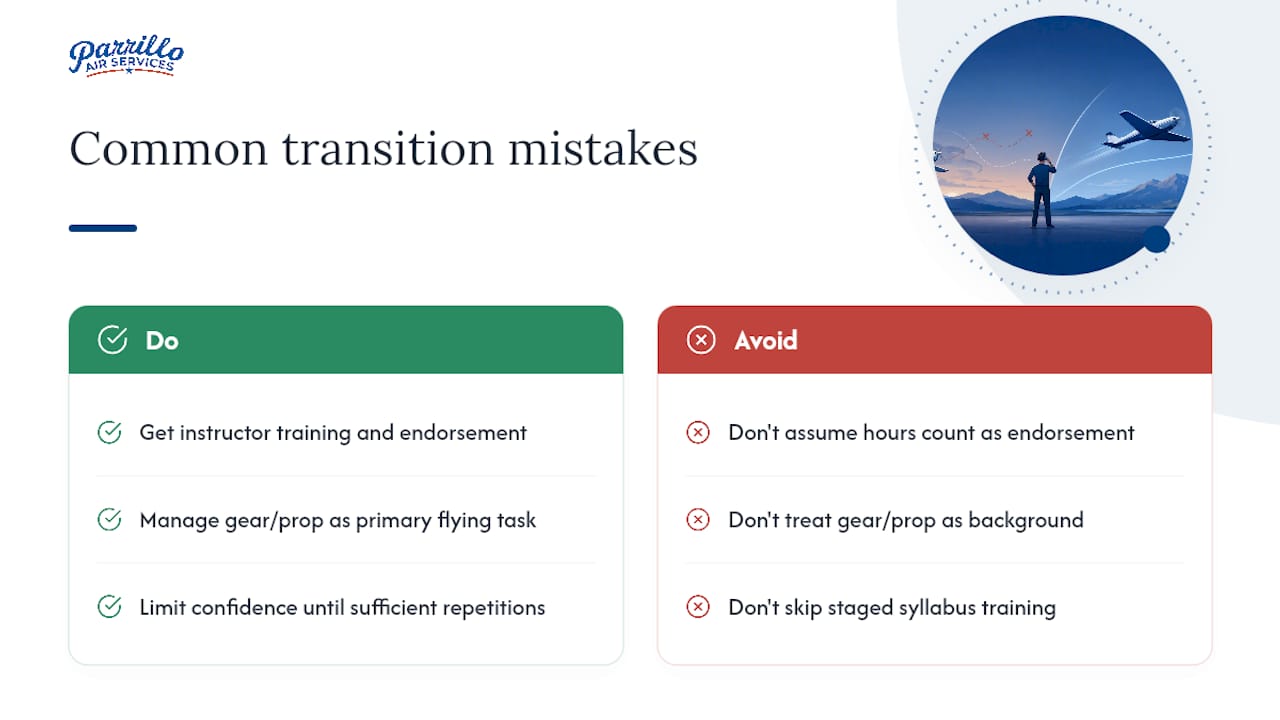
The single most common mistake isn't a piloting error. It's the assumption that logging hours in a complex or high-performance airplane substitutes for the actual endorsement requirement. It doesn't. The FAA rule is explicit: you need documented training from an authorized instructor plus a specific logbook entry certifying proficiency, regardless of how many hours you've accumulated in the airplane otherwise.
The second mistake is treating gear and prop management as background tasks instead of primary flying duties. New complex pilots frequently fixate on airspeed and altitude the way they did in a trainer, and let gear position or prop pitch slip to the back of their attention. That's exactly the wrong priority order in an airplane where a missed gear cycle turns into an expensive, and occasionally dangerous, landing.
The third mistake shows up in high-performance transitions specifically: underestimating how much faster everything happens. Airspeed builds quicker, torque effects are stronger, and the decision window during takeoff and initial climb shrinks noticeably compared to a 172 or Cherokee. Pilots who skip staged, syllabus-based training and jump straight into solo flying in a high-performance airplane are the ones most likely to get behind the airplane during exactly the phase of flight where there's the least room for it.
Avoiding these three problems is mostly about training discipline: log every session, treat configuration management as flying, not paperwork, and don't let confidence outpace your actual repetitions in the airplane.
Neither endorsement is a certificate. They don't show up as a rating on your pilot certificate itself, and they don't gate your progression toward instrument, commercial, or ATP the way a checkride does. But they show up indirectly, and often at exactly the moment you need them least expected.
Commercial pilot training frequently intersects with the complex endorsement, since many training tracks have historically used complex airplane time to satisfy commercial certificate requirements for single-engine applicants. If you're building toward a commercial certificate, getting the complex endorsement early, rather than scrambling for it right before your checkride, keeps your timeline predictable.
For pilots aiming at a regional or major airline career, high-performance and complex time also matters for building a well-rounded logbook that insurance underwriters and hiring departments look at favorably. It signals you've handled airplanes with real systems complexity, not just simple trainers, before stepping into a turbine aircraft during airline-sponsored training.
The practical takeaway: don't treat these endorsements as an afterthought bolted onto your training plan. Sequence them deliberately, ideally with input from whichever instructor is guiding your overall certification pathway, so the airplane you train in also serves your next certificate rather than becoming a detour.
At Parrillo Air Services, endorsement training runs through the same Part 61 structure we use for certificate training generally: personalized instruction built around your schedule, not a rigid class calendar. The syllabus is built around the specific airplane or representative training device being worked toward, covering systems, POH limits, and emergency procedures before flight.
Safety drives the pace. Sign-off occurs only when the instructor is confident the student can handle gear, prop, and power management under both normal and abnormal conditions. That's the standard the FAA sets.
Skipping straight to solo practice in a complex or high-performance airplane, without a syllabus behind it, is how pilots end up with gaps they don't discover until an emergency forces the issue. High-performance and complex endorsement training under Part 61 includes ground and flight instruction sequenced around the specific airplane being trained toward, not a generic checklist.

If you're building toward a commercial certificate, a career track, or just want to rent a faster airplane for cross-country trips, the fastest way to get a clear answer on what your training will look like is to ask directly. Schedule a discovery flight or request a syllabus outline through our flight training program details, and we'll walk you through exactly what your logbook needs before your instructor can sign off.
Train with personalized Part 61 instruction from Parrillo Air Services in Lynchburg, VA.
Get in TouchMost student pilots hear "complex" and "high-performance" and assume the FAA is just adding red tape. It's worth pushing back on that instinct. Separating these two endorsements in 1997 actually reflects two genuinely different skill sets, and treating them as one blurry category, the way older regulations did, made it too easy for pilots to think they'd covered both risks by training for one.
Here's the distinction that gets lost in most explainer articles: a high-performance endorsement is fundamentally about respecting how fast things happen. A complex endorsement is fundamentally about respecting how many things you're tracking at once. Those are different cognitive demands, and conflating them does new pilots a disservice. A pilot who's sharp on rapid decision-making in a powerful airplane isn't automatically good at juggling gear, flaps, and prop pitch in sequence, and vice versa.
The grandfather clause is the part I'd flag as underappreciated. Pilots flying today under pre-1997 qualifying time are legally covered, but that doesn't mean their skills have kept pace with three decades of airplane and avionics changes. If your logbook relies on that grandfather provision, treating it as a green light to skip refresher training is a mistake, even though nothing in the regulation forces your hand. The rule protects your paperwork. It doesn't protect you from a gear-up landing if you haven't practiced the checklist in years.
— Gm