Aviation career salary expectations are defined by role, employer type, and years of experience, ranging from around $30,000 for entry-level flight instructors to over $400,000 for senior cargo airline captains. The gap between those two figures is real, and understanding what drives it is the most useful thing any aspiring pilot can do before committing to training. Seniority, airline category (regional vs. major), and the certifications you hold all determine where you land on the pay scale. Parrillo Air Services works with students at every stage of this path, from first discovery flights to commercial and flight instructor ratings, so the numbers below reflect the career you are actually building toward.
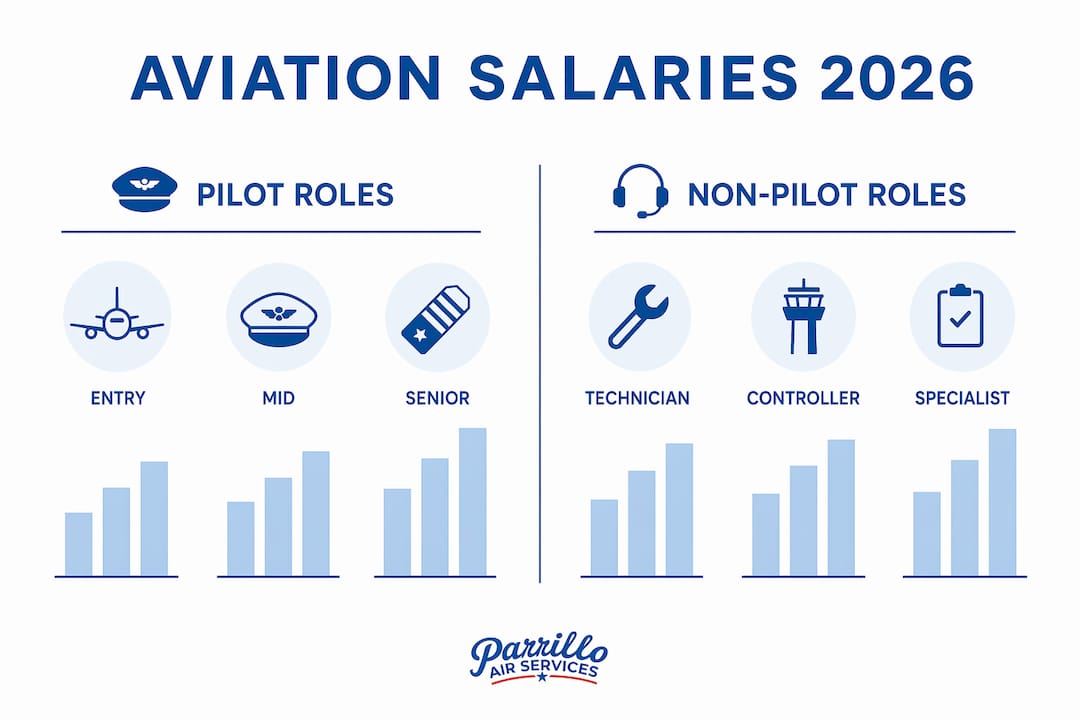
Pilot compensation follows a clear progression tied to certificates, hours, and employer type. Entry-level flight instructors earn $30,000–$60,000 annually, which reflects the hours-building phase of a pilot career rather than a permanent pay ceiling. Regional first officers, the next major step, typically start between $60,000 and $100,000 with signing bonuses of $20,000–$40,000 added on top.
Mid-career pay climbs sharply once a pilot reaches regional captain or moves to a major airline as a first officer. The biggest jump comes at the top: senior widebody captains at major U.S. airlines earn $350,000–$420,000 or more annually. Cargo pilots at carriers like FedEx and UPS can exceed $450,000, generally out-earning passenger airline pilots by $50,000–$100,000 per year.

Pay structure also matters. Pilots are paid for "block time," meaning the hours the aircraft is moving. Hourly rates range from $45–$70 for regional first officers to over $350 for major airline captains, with monthly block hours averaging around 75. That structure means total annual pay depends heavily on the routes and aircraft you fly.
Here is a quick breakdown of pilot pay by career stage:
Flight instructor (CFI): $30,000–$60,000
Regional first officer: $60,000–$100,000 plus signing bonuses
Regional captain: $100,000–$180,000
Major airline first officer: $130,000–$250,000
Major airline captain (narrowbody): $250,000–$350,000
Major airline captain (widebody): $350,000–$420,000+
Cargo airline captain (FedEx/UPS): $400,000–$450,000+
Pro Tip
Total compensation includes base salary, signing bonuses, profit sharing, 401(k) contributions, healthcare, and travel privileges. Always evaluate the full package, not just the base figure, when comparing offers.
Major airlines have raised pilot pay 30–40% since 2023 collective bargaining agreements. That shift permanently reset the salary floor across the industry and makes the career more financially attractive than it was even five years ago.
Seniority is the single most powerful variable in a pilot's financial life. It governs pay scale, aircraft assignment, schedule, and base location. A first-year first officer and a 12-year first officer at the same airline can have over $100,000 difference in pay for the same job title. That gap exists because seniority number directly determines which pay band a pilot occupies on the contract scale.
The practical impact of seniority extends beyond the paycheck. Senior pilots pick their schedules first, choose their aircraft type, and select their preferred base city. Junior pilots take what remains. This reality means the lifestyle you experience in year two at an airline looks very different from year 15.
Seniority is the currency of an airline career. Obtaining it early at a major airline or cargo carrier is the single most critical decision for long-term earning potential. Every year spent building seniority at the right employer compounds in your favor.
Switching airlines resets your seniority to zero. That reset can cost a pilot years of pay progression and schedule quality. The decision to switch airlines should be treated as a major financial decision, not just a career preference.
Reaching captain status at a regional airline typically takes 3–7 years depending on the carrier's growth rate. Moving from a regional to a major airline restarts the seniority clock, but the pay scale at the major is high enough that even a junior major airline first officer often earns more than a senior regional captain.
Pro Tip
Target a major airline or cargo carrier as early as your qualifications allow. Every additional year of seniority at that level is worth far more than an extra year as a senior regional captain.
Pilots get most of the attention, but the aviation industry supports a wide range of well-paying careers that do not require a commercial certificate. Air traffic controllers represent one of the strongest options. Experienced controllers regularly exceed $150,000 annually, and the role carries federal benefits, retirement security, and a structured advancement path through the FAA.
Aircraft maintenance technicians (AMTs) earn a median of $78,680–$81,390 annually. That figure rises significantly with experience and specialization. Maintenance supervisors and lead inspectors earn $100,000–$140,000, with overtime adding another 20–30% to annual earnings. Maintenance roles are also projected to grow 5% from 2024 to 2034, faster than the national average for all occupations.
Avionics specialists, who install and maintain aircraft electronics, sit at the higher end of the technician pay range. Employers increasingly seek candidates with current certifications and demonstrated hands-on skills. Those who arrive with immediate readiness and relevant credentials consistently land in higher compensation bands.
A quick comparison of entry-level vs. experienced pay across key non-pilot roles:
| Role | Entry-Level Pay | Experienced Pay |
|---|---|---|
| Air traffic controller | $50,000–$70,000 | $130,000–$160,000+ |
| Aircraft maintenance technician | $45,000–$60,000 | $78,680–$100,000 |
| Maintenance supervisor / lead inspector | $80,000–$95,000 | $100,000–$140,000 |
| Avionics specialist | $50,000–$65,000 | $85,000–$110,000 |
Each of these paths requires specific FAA certifications or federal training programs. The investment in those credentials pays off quickly given the demand and the salary growth trajectory.
Training costs are the first financial reality every aspiring pilot faces. Total flight training costs from private pilot license through Airline Transport Pilot (ATP) certificate typically range from $60,000 to $150,000 depending on the school, program type, and how quickly you progress. That is a real number, and it deserves honest planning.
The good news is that the return on that investment has improved dramatically. Since 2020, pilot salaries increased 30–50% due to industry-wide pilot shortages. Many pilots now achieve positive ROI on training costs within 3–5 years of starting airline employment. Over a 30-year airline career, lifetime earning potential is estimated at $8 million–$15 million.
Airline tuition reimbursement programs have also changed the math. These programs can offset $40,000–$150,000 of training costs, effectively turning a major expense into a manageable one. Many regional airlines offer these programs as a direct recruiting tool, and some tie reimbursement to a commitment to fly for the carrier for a set number of years.
Here is a practical sequence for managing training costs and building toward positive ROI:
Earn your private pilot license (PPL) as the foundation. Costs vary by location and school, but this is the first required step.
Add instrument and commercial ratings to qualify for paid flying work.
Become a certified flight instructor (CFI) to build hours while earning income.
Apply to regional airlines with signing bonuses and tuition reimbursement programs.
Build seniority at the regional level while targeting a major airline upgrade as soon as you meet minimums.
Pro Tip
Ask every regional airline you interview with about their tuition reimbursement program and the specific terms. Some programs are significantly more generous than others, and the details matter for your financial plan.
Early career pay as a CFI or regional first officer will feel modest relative to the training investment. That phase is temporary. The pilot pay scales at major airlines reward patience with compounding seniority gains that accelerate earnings sharply after year five.
Aviation career earnings peak after 10–20 years of seniority, but the path from flight instructor to major airline captain follows a predictable, well-documented progression that rewards early commitment and strategic career decisions.
| Point | Details |
|---|---|
| Salary range is wide | Pay spans $30,000 for CFIs to $450,000+ for senior cargo captains depending on role and experience. |
| Seniority drives everything | A 12-year first officer can earn $100,000 more than a first-year first officer at the same airline. |
| Training costs are recoverable | Most pilots recoup $60,000–$150,000 in training costs within 3–5 years of airline employment. |
| Non-pilot roles pay well | Air traffic controllers exceed $150,000; maintenance supervisors reach $100,000–$140,000. |
| Total compensation matters | Signing bonuses, profit sharing, and benefits can add tens of thousands to base salary annually. |
The salary numbers in aviation look either discouraging or unrealistic depending on which end of the range you focus on. I have seen aspiring pilots walk away from the career after seeing CFI pay, and I have seen others enter training expecting to earn $300,000 within five years. Both reactions miss the point.
The honest truth is that aviation is a career with a slow start and a steep finish. The first five years require patience and financial discipline. The next twenty years reward that patience in ways that few other careers can match. A 30-year airline career with a major carrier or cargo operator is one of the highest-earning paths available to someone without a graduate degree.
The lifestyle trade-offs are real, though. Irregular schedules, time away from home, and years of building seniority before you control your own calendar are not small things. The pilots who thrive long-term are the ones who planned for those realities before they started training, not after. Passion for flying matters, but so does a clear-eyed financial and lifestyle plan. The two are not in conflict. They are both required.
— Gm
Knowing the salary ranges is one thing. Building the qualifications to reach them is another. Parrillo Air Services offers FAA-certified flight training programs in Lynchburg, VA, designed to take you from your first flight to commercial and flight instructor ratings with personalized instruction and flexible scheduling.

The programs at Parrillo Air Services align directly with the career pathway that leads to regional and major airline employment, the same pathway where seniority and salary growth compound over time. Whether you are exploring aviation for the first time or ready to commit to a professional pilot program, the team at Parrillo Air Services can walk you through training requirements, costs, and realistic timelines. Visit Parrillo Air Services to learn more about getting started.
Entry-level flight instructors earn $30,000–$60,000 annually, while regional first officers typically start at $60,000–$100,000 plus signing bonuses of up to $40,000.
Senior cargo airline captains at carriers like FedEx and UPS can earn $450,000 or more annually, making cargo aviation the highest-paying pilot sector.
Most pilots recover $60,000–$150,000 in training costs within 3–5 years of starting airline employment, especially when airline tuition reimbursement programs are factored in.
Switching airlines resets your seniority to zero, which can cost years of pay progression and schedule quality. The financial impact of a seniority reset should be carefully evaluated before making a move.
Air traffic controllers are the highest-paid non-pilot role, regularly exceeding $150,000 annually. Maintenance supervisors and lead inspectors follow at $100,000–$140,000, with overtime adding another 20–30%.