
A type rating is a specific certification endorsement that the FAA requires before any pilot can act as pilot in command of certain aircraft. Under 14 CFR § 61.31, two conditions trigger this requirement: the aircraft exceeds 12,500 lbs maximum takeoff weight (MTOW), or it is turbojet powered, regardless of weight. That second condition surprises a lot of pilots. A light business jet weighing 6,000 lbs still demands a type rating because of its engines, not its size.
Type ratings are aircraft-specific endorsements printed directly on your pilot certificate. They are not broad category authorizations. Common aircraft that require them include:
The governing regulation is 14 CFR § 61.31, and it applies whether you hold a commercial certificate or an ATP. The rating tells the world you have demonstrated proficiency in that specific aircraft, not just aircraft like it.
The FAA's framework here is tighter than most pilots initially expect. 14 CFR § 61.31(a) sets the threshold plainly: pilot in command of a large aircraft (over 12,500 lbs MTOW) or any turbojet-powered airplane must hold a type rating for that aircraft. The rule is an "or" condition, not "and." A heavy piston aircraft like the DC-3 qualifies on weight alone, while an Eclipse 500 qualifies on propulsion alone despite weighing far less than many turboprops that need no type rating at all.
14 CFR § 61.31(a): "A person who acts as a pilot in command of any of the following aircraft must hold a type rating for that aircraft: Large aircraft [or] turbojet-powered airplanes."
A few important distinctions pilots often overlook:
The FAA also recognizes that a single type rating often covers multiple variants within an aircraft family, but not always. A Boeing 737 rating does not automatically cover the Boeing 757. Each type rating is tied to specific FAA model designations, so verifying the exact endorsement you need before PIC operations is not optional.
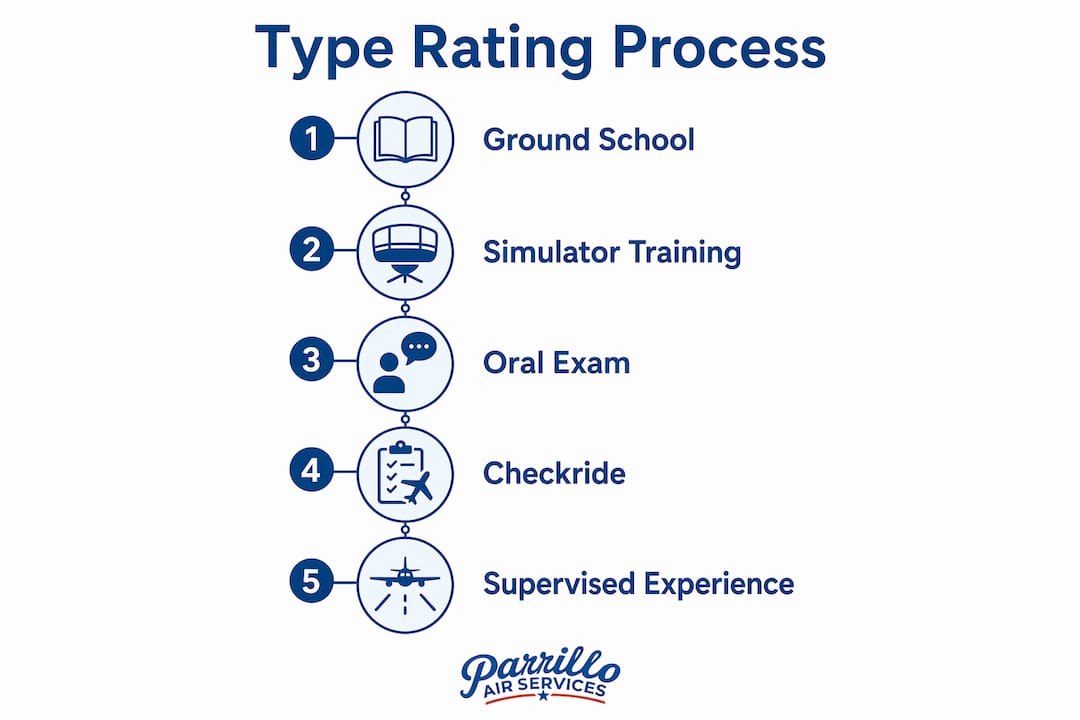
The aircraft type rating process follows a consistent structure, though the specifics vary by aircraft complexity and your existing experience level.
Ground school comes first. You will study aircraft systems in depth: hydraulics, pressurization, fuel, electrical, avionics, and emergency procedures. This is not a light review. Oral exams for type ratings test memory items and limitations to a standard that catches underprepared pilots off guard.

Simulator training is where most of the hands-on work happens. The FAA recognizes Zero Flight Time Training (ZFTT) for qualified pilots, meaning you can complete the entire rating in a high-fidelity Level D full-motion simulator without ever flying the actual aircraft. This approach is cost-effective and, given the fidelity of modern Level D devices, fully prepares you for real-world operations. For aircraft with no simulator, or when pilots prefer it, training in the actual aircraft remains an option.
The oral examination covers systems knowledge, aircraft limitations, emergency procedures, and regulatory compliance. Examiners expect you to know memory items cold and to reason through abnormal situations accurately.
The practical checkride is conducted either in a Level D simulator or the aircraft itself, with an FAA Designated Pilot Examiner. The maneuvers tested align with ATP practical test standards, regardless of whether you hold a commercial or ATP certificate. Expect two precision approaches, two nonprecision approaches, engine-out scenarios, and abnormal or emergency procedures woven throughout.
Supervised Operational Experience (SOE) applies to pilots with limited turbine experience who earn their first type rating entirely in a simulator. In that case, you fly with a fully qualified PIC for a set period before acting as PIC yourself.
Pro Tip: If you are pursuing your first jet type rating, ask your training provider specifically whether SOE will apply to you. The answer depends on your total turbine time, and knowing in advance lets you plan your schedule and budget accordingly.
Training duration for a type rating varies, typically lasting from a short period to several weeks depending on aircraft complexity and the training method. Light jets require less time for combined classroom and simulator training, while large airliner type ratings take longer, especially with initial operating experience included.
Cost factors break down across several categories:
Who pays depends heavily on context. Airline pilots typically have type rating training covered by their employer, either before or shortly after hire. Corporate and charter pilots sometimes self-fund, particularly when adding a rating to increase marketability. Pilots pursuing a type rating independently, such as for a personally owned aircraft, bear the full cost themselves.
Light jet type ratings generally cost less than ratings for large transport-category aircraft, where simulator time alone commands premium rates. Budgeting realistically means accounting for travel, lodging near the training center, and study materials in addition to direct training fees.
The FAA and the European Union Aviation Safety Agency (EASA) share the same underlying logic, both requiring type ratings for complex or large aircraft, but the details diverge in ways that matter if you fly internationally.
Under FAA rules, the turbojet threshold applies to any jet regardless of weight, and domestic SIC operations in the United States do not require a type rating beyond general category and class ratings. EASA, by contrast, generally requires both crew members of a two-pilot aircraft to hold a full type rating, with no equivalent to the FAA's SIC-specific type rating for domestic operations. This means a U.S.-certificated copilot flying internationally may need to obtain an SIC type rating specifically to satisfy the destination country's requirements.
EASA type ratings are issued under Part-FCL regulations and are tied to the European licensing system. An FAA type rating does not automatically transfer to an EASA license, and vice versa. Pilots holding both FAA and EASA licenses must maintain separate type rating endorsements on each, which adds training and currency requirements. The International Civil Aviation Organization (ICAO), through Annex 1 to the Convention on International Civil Aviation, sets the international framework that both authorities work within, but each authority retains discretion over which aircraft require type ratings and how training is structured.
For pilots pursuing airline careers with international routes, understanding both systems is practical, not theoretical.
The most common misconception pilots bring into type rating training is that weight alone determines whether a rating is required. The turbojet rule catches people off guard consistently. A pilot who has flown large turboprops for years without a type rating will still need one the first time they sit left seat in even a small business jet.
The oral exam is where type rating candidates most often stumble. Systems knowledge must be precise, not approximate. Examiners expect memory items recited accurately and emergency procedures reasoned through correctly under pressure. Showing up with a general familiarity with the aircraft is not enough.
Simulator training has genuinely changed what type rating preparation looks like. The fidelity of a Level D device means that ZFTT is not a shortcut; it is a legitimate and thorough path to proficiency. Pilots who invest time in simulator sessions before the formal training period often perform noticeably better on checkrides.
The difference between a PIC and SIC type rating matters beyond the paperwork. A commercial pilot certificate with a type rating carries limitations that an ATP does not. If your goal is airline PIC operations, the type rating is one piece of a larger certification picture.
Recurrent training is where proficiency is actually maintained, not just demonstrated once. Periodic proficiency checks keep pilots sharp on emergency procedures and systems knowledge that can fade without regular review. Pilots who treat recurrent training as a formality rather than genuine preparation tend to show it when abnormal situations arise.
At Parrillo Air Services, the foundation built through instrument rating training and commercial certification directly supports type rating readiness. The procedural discipline, systems thinking, and cockpit management skills developed earlier in training are exactly what examiners look for during a type rating checkride.
A type rating is an aircraft-specific FAA certification required for any turbojet-powered airplane or any aircraft exceeding 12,500 lbs MTOW, governed by 14 CFR § 61.31, and maintained through annual proficiency checks.
| Point | Details |
|---|---|
| Two triggers, not one | A type rating is required for aircraft over 12,500 lbs MTOW or any turbojet, whichever applies first. |
| Aircraft-specific endorsement | A Boeing 737 type rating does not cover the Boeing 757; each rating ties to specific FAA model designations. |
| Training path | Ground school, Level D simulator sessions, oral exam, and a practical checkride to ATP standards are all required. |
| Duration and recurrence | Training typically runs one to four weeks; proficiency checks are required annually to keep the rating active. |
| ATP needed for Part 121 PIC | A type rating on a commercial certificate carries restrictions; full airline PIC authority requires an ATP plus the type rating. |
Type ratings occupy a different tier of pilot certification than most pilots appreciate before they start. The checkride is conducted to ATP standards regardless of what certificate you hold. That means a commercial pilot adding a type rating is being evaluated at the same level as an airline transport pilot. That standard is not arbitrary; it reflects the actual demands of operating complex aircraft where systems failures require immediate, accurate responses.
The confidence that follows a successful type rating is earned, not given. Pilots who complete the process describe a shift in how they approach cockpit management, emergency procedures, and systems awareness. The training forces a level of precision that carries over into every flight afterward.
For pilots building toward airline careers, the type rating fits into a progression that includes regional airline qualifications and eventually major airline standards. Each step builds on the last, and the discipline instilled during type rating training is visible to every chief pilot who reviews a candidate's record.
Choosing an FAA-certified training provider matters more than pilots sometimes realize. The quality of ground instruction, the depth of simulator preparation, and the rigor of pre-checkride evaluations vary. Parrillo Air Services builds pilots from the ground up with the procedural foundation that type rating training demands. If you are ready to take the next step, explore flight training programs and find out how structured, FAA-certified instruction prepares you for every rating ahead.
