
Accelerated pilot training is defined as a condensed flight education program that compresses the standard training timeline by scheduling lessons at high frequency, typically 5–6 days per week, rather than once or twice weekly. Aspiring pilots who want to know what accelerated training means will find the answer is not fewer hours but smarter use of those hours. The FAA's required flight hours stay fixed regardless of training pace. What changes is how quickly those hours stack up, and how well your skills hold between sessions. Parrillo Air Services offers FAA Part 61 instruction built around exactly this kind of focused, consistent progression.
Accelerated pilot training is a method to achieve proficiency efficiently, not a way to bypass mandated flight hour requirements. The FAA sets minimums for every certificate, and no accelerated program reduces those totals. What the format changes is the spacing between lessons, and that spacing matters more than most aspiring pilots realize.
Traditional training schedules one or two lessons per week. Between those sessions, the forgetting curve quietly erodes what you learned. You show up the following week and spend the first 20 minutes rebuilding skills you already had. Accelerated training blocks that forgetting curve by keeping you in the cockpit nearly every day, so each lesson builds directly on the one before it.
The result is a tighter feedback loop. You practice a maneuver, debrief it the same afternoon, and repeat it the next morning. That cycle builds procedural memory far faster than a once-a-week schedule ever could. For aspiring pilots with a clear career goal, that speed of skill acquisition is the core appeal of the accelerated model.

The structure of an accelerated flight training program follows a daily rhythm that most students find demanding but logical once they settle into it.
A typical week looks like this:
This daily cycle runs 5–6 days per week, which is what separates accelerated flight training from a standard part-time schedule. The frequency creates training momentum, and that momentum is the mechanism behind faster certification timelines.
Pro Tip: Set a fixed study block every evening, even on days you fly. Thirty minutes of chair-flying before bed reinforces the lesson far better than a longer session two days later.
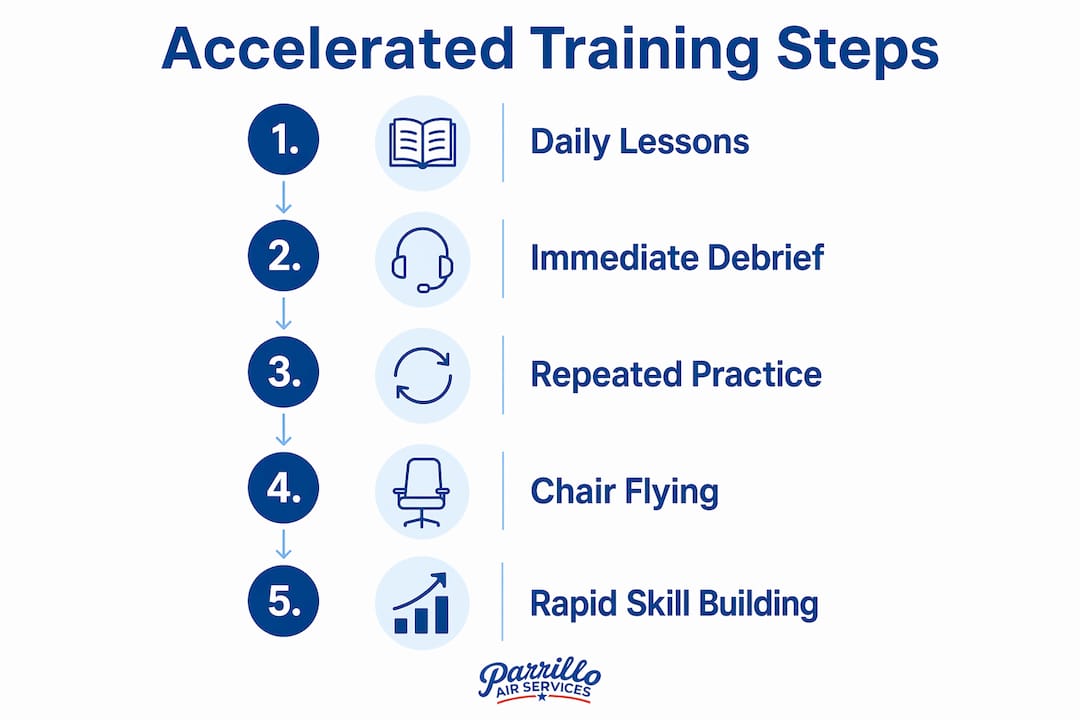
Contrast this with traditional training, where a student might fly on Saturday, review notes on Sunday, and not fly again until the following Saturday. Seven days is enough time for procedural memory to fade noticeably. The accelerated model eliminates that gap by design.
The benefits of accelerated training for pilots go beyond a faster certificate. The format changes how deeply skills are absorbed and how confidently they are applied.
The retention advantage is the most underrated benefit. Students in traditional programs often plateau because gaps between lessons let small errors calcify into habits. Accelerated students correct errors the next day, before bad habits form.
Accelerated flight training is not the right fit for every aspiring pilot. The same intensity that drives fast results also creates real pressure.
Pro Tip: Before committing to an accelerated program, complete at least 2–3 introductory lessons at a standard pace. If you struggle to absorb basic concepts in that window, build your fundamentals first.
Mental preparation and dedication are the factors flight instructors consistently identify as critical for success. The students who struggle most are not those with less natural ability. They are the ones who underestimate the daily mental load before they start. Reviewing the time commitment involved in flight training before enrolling gives you a realistic baseline.
Both formats produce safe, certified pilots when matched correctly to the student. The differences lie in pacing, lifestyle impact, and how skills develop over time.
| Factor | Accelerated training | Traditional training |
|---|---|---|
| Lesson frequency | 5–6 days per week | 1–2 days per week |
| Time to private pilot certificate | Weeks to a few months | 12–24 months typical |
| Skill retention between lessons | High, due to daily repetition | Lower, forgetting curve applies |
| Daily time commitment | Full-time equivalent | Part-time compatible |
| Up-front financial concentration | High | Spread over longer period |
| Best suited for | Students with full availability and strong fundamentals | Students balancing work, school, or family |
Traditional training suits aspiring pilots who cannot step away from work or other obligations for an extended period. The slower pace allows for reflection and gradual absorption, which works well for students who need more time with complex concepts like instrument procedures or cross-country planning.
Accelerated training suits students who can commit fully for a defined period and who enter with solid study habits. The format rewards preparation. Students who arrive with strong ground knowledge move through the syllabus faster and experience less of the plateau effect described above. Understanding the full pilot training stages before choosing a format helps you match the program to where you actually are, not where you hope to be.
Neither format is inherently superior. The best training program is the one that matches your current readiness, your schedule, and your long-term goals.
Accelerated pilot training compresses certification timelines through daily lessons and disciplined study, not by reducing FAA-required flight hours or cutting corners on safety.
| Point | Details |
|---|---|
| FAA hours stay fixed | Accelerated training compacts required hours efficiently; it does not reduce them. |
| Daily frequency drives retention | Flying 5–6 days per week blocks the forgetting curve and builds muscle memory faster. |
| Chair-flying is non-negotiable | Mental simulation of procedures outside the cockpit reinforces each lesson and keeps pace. |
| Intensity demands readiness | Students without solid fundamentals risk superficial learning under a compressed schedule. |
| Match format to your life | Accelerated suits full-time students; traditional suits those balancing other commitments. |
Most aspiring pilots hear "accelerated" and picture a rushed program where instructors push students through checkrides before they are ready. That picture is wrong, and believing it leads to poor decisions in both directions.
The biggest misconception is that accelerated means rushing. It means disciplined, daily repetition. The difference matters enormously. Rushing skips steps. Daily repetition builds them faster. A student who flies every day for six weeks and studies every evening is not being rushed. That student is being trained the way professional pilots actually develop proficiency.
What I have seen consistently is that the students who thrive in accelerated programs are not necessarily the most naturally gifted. They are the most prepared and the most honest with themselves about their readiness. They show up having already read the lesson material. They chair-fly before bed. They ask questions during debrief instead of nodding along.
The students who struggle are often the ones who chose the format for the wrong reason. Speed is a byproduct of the accelerated model, not its purpose. If your primary motivation is to finish fast rather than to train well, the format will expose that gap quickly.
Both accelerated and traditional programs can produce excellent pilots. The question is not which format is better. The question is which format matches who you are right now, not who you plan to be by the time training starts. Be honest about your fundamentals, your schedule, and your mental stamina before you commit. That honesty is the most important pre-flight check you will ever do.
— Gm
Parrillo Air Services, based in Lynchburg, VA, offers FAA Part 61 flight training built around personalized instruction and flexible scheduling. Whether you are drawn to an intensive pace or prefer a steadier progression, the programs cover everything from introductory discovery flights through private pilot, instrument, commercial, and flight instructor ratings.

The instructors at Parrillo Air Services work with each student to match training pace to real readiness, not just availability. If you are weighing your options and want to understand exactly what each program involves, the flight training program details page lays out costs, requirements, and next steps clearly. Choosing the right pace from the start is the decision that shapes everything that follows.